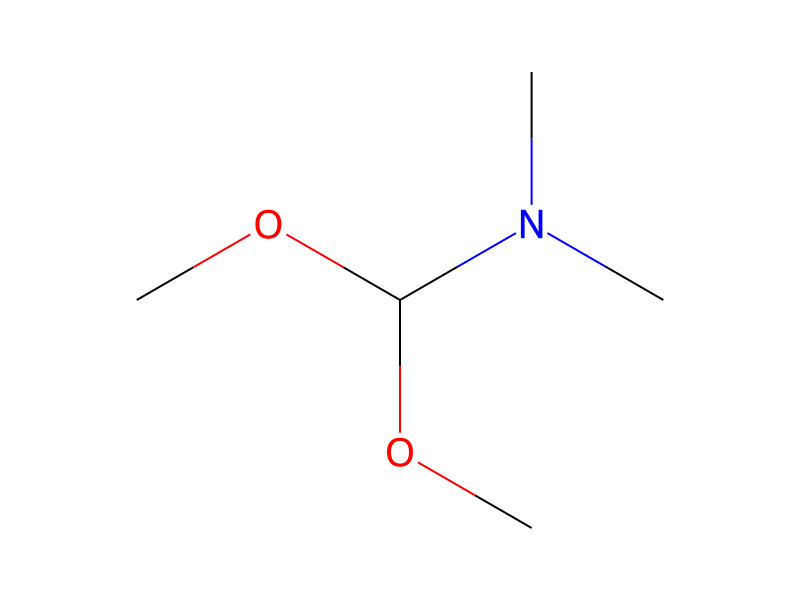
Dimethylformamide dimethyl acetal → tert-Butyl 3-[(dimethylamino)methylidene]-4-oxopyrrolidine-1-carboxylate
Reaction equation

[O:1]([C:6]([N:8]1[CH2:12][CH2:11][C:10](=[O:13])[CH2:9]1)=[O:7])[C:2]([CH3:5])([CH3:4])[CH3:3].CO[CH:16](OC)[N:17]([CH3:19])[CH3:18]>>[CH3:16][N:17]([CH:19]=[C:11]1[C:10](=[O:13])[CH2:9][N:8]([C:6]([O:1][C:2]([CH3:5])([CH3:3])[CH3:4])=[O:7])[CH2:12]1)[CH3:18]Participants
3


Procedure
A solution of 1-(tert-butoxylcarbonyl)-3-pyrrolidone (4.10 g) and N,N-dimethylformamide dimethyl acetal (30.0 mL) was heated to 140° C. for 1 h. The resulting mixture was cooled to room temperature and concentrated under reduced pressure. The residue was redissolved in a minimum amount of dichloromethane and triturated with hexane to yield a yellow precipitate. LC-MS=241.1 (M+1).
Workup
- concentrationconcentrated under reduced pressure
- dissolutionThe residue was redissolved in a minimum amount of dichloromethane
- customtriturated with hexane
- customto yield a yellow precipitate
Sources & evidence
- ORD record
- ord-4febb7ba25a44d73a2ff288fa50b85b8
- Source dataset
- uspto-grants-2014_02
- Patent number
- US08653059B2
Reaction notes
Loading…