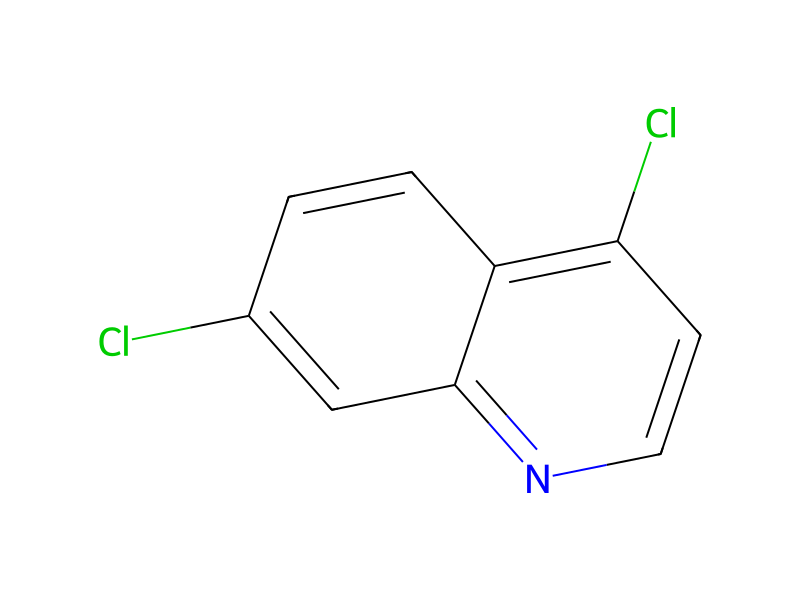
4,7-Dichloroquinoline → HCID 178511631, compound
Reaction equation

Cl[C:2]1[C:11]2[C:6](=[CH:7][C:8]([Cl:12])=[CH:9][CH:10]=2)[N:5]=[CH:4][CH:3]=1.[CH:13]1([NH2:20])[CH2:18][CH2:17][CH:16]([NH2:19])[CH2:15][CH2:14]1>C(O)C>[Cl:12][C:8]1[CH:7]=[C:6]2[C:11]([C:2]([NH:19][C@H:16]3[CH2:17][CH2:18][C@@H:13]([NH2:20])[CH2:14][CH2:15]3)=[CH:3][CH:4]=[N:5]2)=[CH:10][CH:9]=1Participants
4
Reactant 2

Product 1

Reagents, catalysts & solvents 1

Conditions
- Temperature
- 250 °C
Procedure
A mixture of 4,7-dichloroquinoline(2 g, 10.2 mmol) and 1,4-cyclohexanediamine (2.5 g, 21.9 mmol) was heated at 250° C. for 15 hours, cooled to room temperature, diluted with ethanol, and filtered. The residue was extracted with chloroform from 50%NaOH solution. The extract was dried with Na2SO4 and MgSO4, filtered and concentrated to give the desired compound. MS (ESI(+)Q1MS m/z 276 (M+H)+.
Workup
- temperaturecooled to room temperature
- filtrationfiltered
- extractionThe residue was extracted with chloroform from 50%NaOH solution
- dry with materialThe extract was dried with Na2SO4 and MgSO4
- filtrationfiltered
- concentrationconcentrated
Sources & evidence
- ORD record
- ord-4c075a080c2645059101ac3dbfcdb5ae
- Source dataset
- uspto-grants-2004_11
- Patent number
- US06818772B2
Reaction notes
Loading…