Piperazine → 3-(1-Piperazinyl)-1,2-benzisothiazole
Reaction equation

Cl[C:2]1[C:6]2[CH:7]=[CH:8][CH:9]=[CH:10][C:5]=2[S:4][N:3]=1.[NH:11]1[CH2:16][CH2:15][NH:14][CH2:13][CH2:12]1.[OH-].[Na+]>>[CH2:13]1[NH:14][CH2:15][CH2:16][N:11]([C:2]2[C:6]3[C:5](=[CH:10][CH:9]=[CH:8][CH:7]=3)[S:4][N:3]=2)[CH2:12]1Participants
4



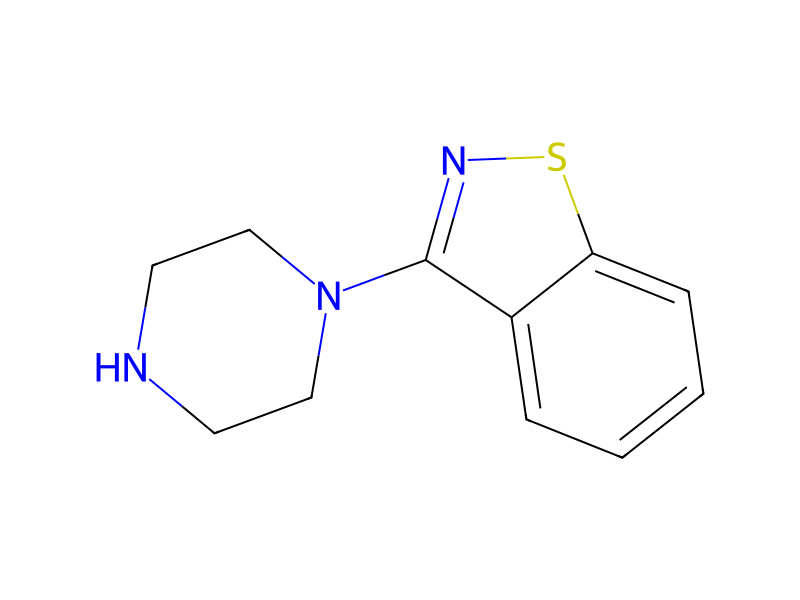
Conditions
- Temperature
- 125 °C
Procedure
3-chloro-(1,2-benzisothiazole) (14 g, 200 mmol) and anhydrous piperazine (6.8 g, 40 mmol) are placed in an egg type flask and heated at 125° C. for 24 hours. After completion of reaction, 52 ml of an ice-water mixture is added for quenching the reaction. The mixture is further added with 3.2 g of 50% NaOH solution, stirred 5 minutes and extracted with CH2Cl2 (50 ml×3). The organic layer is washed with an ice-water mixture (50 ml×2) and saturated saline (50 ml×2), and dried over anhydrous MgSO4 to obtain 4-(1,2-benzisothiazol-3-yl)-1-piperazine.
Workup
- additionis added
- customfor quenching
- customthe reaction
- extractionextracted with CH2Cl2 (50 ml×3)
- washThe organic layer is washed with an ice-water mixture (50 ml×2) and saturated saline (50 ml×2)
- dry with materialdried over anhydrous MgSO4
Sources & evidence
- ORD record
- ord-ca76e14302c14f7ba0763a1529c3d3e7
- Source dataset
- uspto-grants-2014_02
- Patent number
- US08653069B2
Reaction notes
Loading…