Iodine → Triphenyl Phosphate
Reaction equation

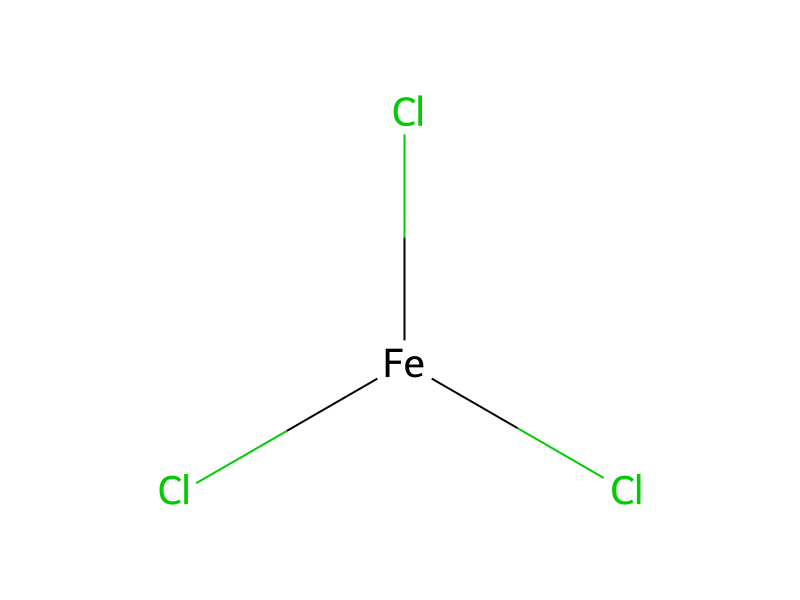
[P:1]([O:16][C:17]1[CH:22]=[CH:21][CH:20]=[CH:19][CH:18]=1)([O:9][C:10]1[CH:15]=[CH:14][CH:13]=[CH:12][CH:11]=1)[O:2][C:3]1[CH:8]=[CH:7][CH:6]=[CH:5][CH:4]=1.II.[O:25]=O>[Fe](Cl)(Cl)Cl>[P:1]([O:9][C:10]1[CH:15]=[CH:14][CH:13]=[CH:12][CH:11]=1)([O:16][C:17]1[CH:22]=[CH:21][CH:20]=[CH:19][CH:18]=1)([O:2][C:3]1[CH:4]=[CH:5][CH:6]=[CH:7][CH:8]=1)=[O:25]Participants
Reactant 3



Product 1

Reagents, catalysts & solvents 1
Procedure
To a one-liter, stainless steel Parr autoclave vessel equipped for agitation, heating/cooling, and gas pressurization were charged 710 grams (2.29 moles) of triphenyl phosphite, 1.78 grams (0.0070 mole; 0.31 mole %) of iodine, and 2.34 grams (0.0144 mole; 0.63 mole %) of anhydrous iron (III) chloride. The mixture was heated to 115°-120° C. with efficient agitation and pressurized with oxygen at 55 psig. These conditions were maintained by applying sufficient cooling to control the accompanying exotherm which subsided after about 2.5 hours. The oxygenation was continued until no oxygen pressure drop was observed when the reaction vessel was isolated from the outside pressure line. The total reaction time was 5 hours. When the reaction vessel was vented, there was obtained 747 grams of triphenyl phosphate, an amber liquid that solidified upon cooling to room temperature. Gas chromatography showed the absence of triphenyl phosphite, thus demonstrating that the conversion of the phosphite to the phosphate was quantitative.
Workup
- temperatureheating/cooling
- temperatureThe mixture was heated to 115°-120° C. with efficient agitation
- temperatureThese conditions were maintained
- temperatureby applying sufficient cooling
- customThe oxygenation
- customwas isolated from the outside pressure line
- waitThe total reaction time was 5 hours
Sources & evidence
- ORD record
- ord-aa787d67c679432794782f51fd152add
- Source dataset
- uspto-grants-1984_09
- Patent number
- US04469644
Reaction notes
Loading…