Hydrochloric Acid → 2-(Naphthalen-2-yl)-1,3-dithiane
Reaction equation

CO[C:3]1C=CC=[CH:5][C:4]=1[C:9]([CH:11]([C:13]1[CH:18]=[CH:17][CH:16]=[CH:15][CH:14]=1)O)=O.C1(C2[S:30][CH2:29][CH2:28][CH2:27][S:26]2)C=CC=CC=1.COC1C=C(C=C(OC)C=1)C(O)C(=O)C1C=CC=CC=1.C(O)(=O)C=C.COC1C=C(C=C(OC)C=1)C(O)C(=O)C1C=CC=CC=1.C(Cl)(=O)C=C.C1C2C(=CC=CC=2)C=CC=1C=O.S1C=CCS1.C(S)CCS.Cl>C(Cl)(Cl)Cl>[CH:5]1[C:14]2[C:13](=[CH:18][CH:17]=[CH:16][CH:15]=2)[CH:11]=[CH:9][C:4]=1[CH:3]1[S:30][CH2:29][CH2:28][CH2:27][S:26]1Participants
Reactant 9
 HCID 313Hydrochloric Acid
 HCID 62012-Naphthalenecarboxaldehyde
 HCID 80131,3-Propanedithiol
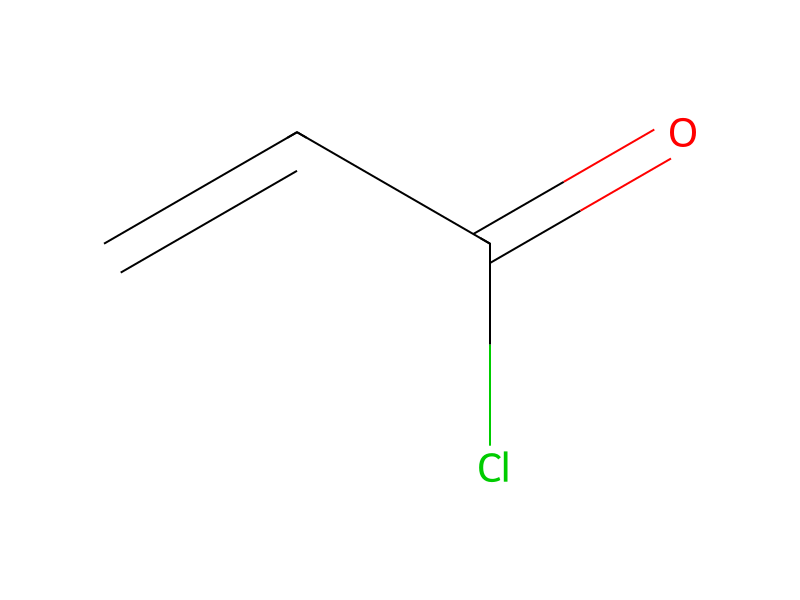 HCID 13140Acryloyl chloride
 HCID 215472-Phenyl-1,3-dithiane
 HCID 5253311,2-Dithiole
 HCID 5555932-(3,5-Dimethoxyphenyl)-2-hydroxy-1-phenyl-ethanone
 HCID 20154532Methoxybenzoin
 HCID 703486503',5'-Dimethoxybenzoin acrylate
Product 1

Reagents, catalysts & solvents 1
Procedure
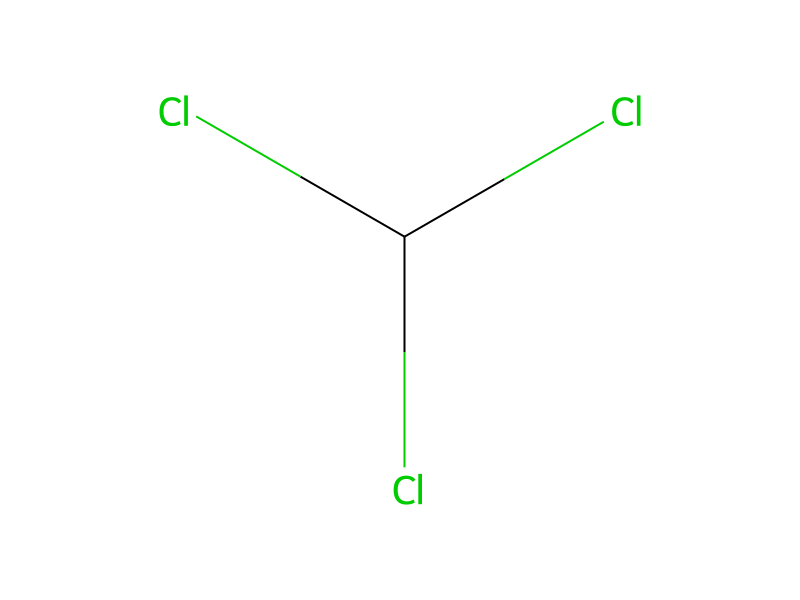
The special characteristic of the polymeric compound of the invention is the methoxybenzoin (3'-; 3',4'-; or 3',5'-) group of the polymer. The compound is photosensitive per se without the presence of other photosensitive groups. The precursors of a polymeric compound, e.g., poly(3',5'-dimethoxybenzoinacrylate), are set forth in Example 1 below. For example, 2-phenyl-1,3-dithiane is prepared as described by Seebach et al., J. Org. Chem. 31, 4303 (1966). This compound is then used to prepare 2-[1-hydroxy-1-(3,5-dimethoxyphenyl)]methyl-2-phenyl-1,3-dithiane by the general procedure described by Seebach et al., J. Org. Chem. 40, 231 (1975). 3',5'-dimethoxybenzoin is subsequently prepared by thioketal hydrolysis according to the general procedure described by Naraska et al., Bull. Chem. Soc. Japan (Tokyo), 45, 3724 (1972). This compound is esterified to 3',5'-dimethoxybenzoin acrylate by known esterification procedures using acryloyl chloride and then is polymerized in a known way to form a polymer of the invention. An alternative procedure for preparing a substituted benzoin acrylate monomer illustrated in Example 3 is as follows: an aldehyde, e.g., β-naphthaldehyde and a dithiol, e.g., 1,3-propanedithiol, are reacted in a solvent, e.g., chloroform saturated with HCl, to form 2-β-naphthyl-1,3-dithiane. To the isolated product in anhydrous tetrahydrofuran is added n-butyllithium/hexane at dry ice/acetone temperature. Subsequently 3,5-dimethoxybenzaldehyde in the same solvent is added and stirred followed 30 minutes later by acryloyl chloride in solvent to form 3,4-benzo-3',5'-dimethoxybenzoin acrylate thioketal. Hydrolysis of the thioketal as described above produces 3,4-benzo-3',5'-dimethoxybenzoin acrylate. It is recognized that analogues of the above compounds can be prepared by the foregoing procedures. The proportions of the various repeating units in the final copolymer can be controlled by controlling the quantities of reactants present during copolymerization.
Workup
- customis polymerized in a known way
- customto form a polymer of the invention
Sources & evidence
- ORD record
- ord-acdb80ef058848cbb5829e8545261bfc
- Source dataset
- uspto-grants-1984_09
- Patent number
- US04469774
Reaction notes
Loading…