Veratraldehyde → HCID 70348734, compound
Reaction equation

[C:1]1([CH:7]2SCCCS2)[CH:6]=[CH:5][CH:4]=[CH:3][CH:2]=1.C([Li])CCC.[CH3:18][O:19][C:20]1[CH:21]=[C:22]([CH:25]=[CH:26][C:27]=1[O:28][CH3:29])[CH:23]=[O:24].C(Cl)(=[O:33])C=C.C([O-])(O)=[O:36].[Na+]>COCCOC.O.C1C=CC=CC=1>[C:27]([OH:28])(=[O:33])[CH:26]=[CH2:25].[CH3:18][O:19][C:20]1[CH:21]=[C:22]([CH:25]=[CH:26][C:27]=1[O:28][CH3:29])[CH:23]([OH:24])[C:7](=[O:36])[C:1]1[CH:6]=[CH:5][CH:4]=[CH:3][CH:2]=1Participants
Reactant 5
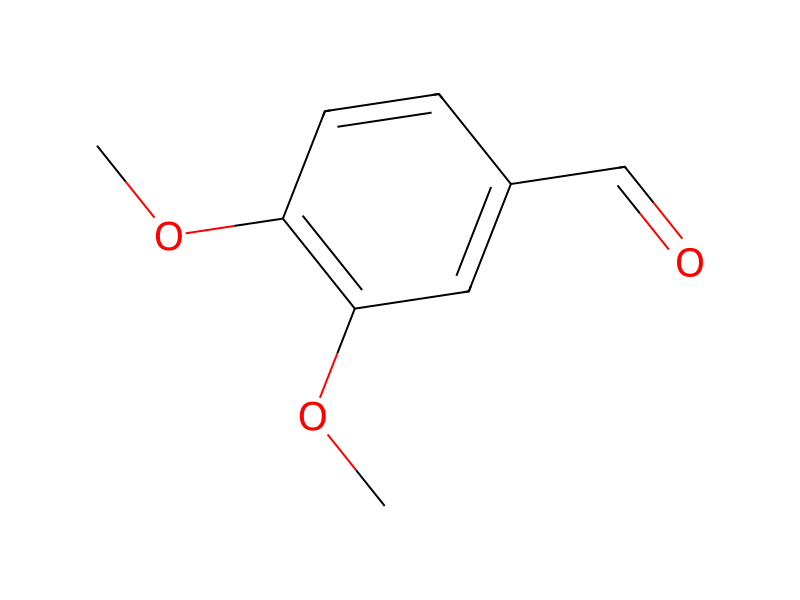




Product 1

Reagents, catalysts & solvents 3



Conditions
- Temperature
- -20 °C
Procedure
A 500 ml 3-necked flask fitted with a nitrogen source in and out, magnetic stirrer, dropping funnel, and serum cap, was charged with 125 ml anhydrous 1,2-dimethoxyethane and 19.6 g (0.1 mole) 2-phenyl-1,3-dithiane, the mixture cooled to -20° C. and 64 ml (43.6 g) of 1.6 molar n-butyllithium was added. To a solution of 16.6 g 3,4-dimethoxybenzaldehyde (0.1 mole) in 25 ml anhydrous 1,2-dimethoxyethane was added dropwise, 8.1 ml (9.05 g) acryloyl chloride in 25 ml 1,2-dimethoxyethane. The mixture was allowed to reach room temperature and stirred for 15 minutes, 100 ml 5% aqueous NaHCO3, 100 ml benzene, were added followed by 100 ml water and the two phases were separated, the organic phase being washed once with 100 ml water. The solvent was vacuum evaporated, the residue dissolved in 600 ml 98% aqueous acetone and 19.5 g CuO and 41.8 g CuCl2 were added. The mixture was refluxed for 1.5 hours, cooled to room temperature, the solid filtered off, rinsed with acetone, and the combined acetone rinse vacuum evaporated. The residue was taken up in 300 ml benzene/200 ml water, the layers separated, the water layer extracted three times with 100 ml benzene and the combined benzene extracts were washed four times with 100 ml water, once with 5% aqueous HCl, once with 5% aqueous NaHCO3, once with 100 ml saturated aqueous Na2SO4, dried with 10 g anhydrous MgSO4, filtered, evaporated under vacuum, and triturated with hexane/benzene (1/1) to give 9.43 g (ca 33%) of 3',4'-dimethoxybenzoin acrylate.
Workup
- customA 500 ml 3-necked flask fitted with a nitrogen source in and out, magnetic stirrer
- customserum cap
- customto reach room temperature
- customthe two phases were separated
- washthe organic phase being washed once with 100 ml water
- customevaporated
- dissolutionthe residue dissolved in 600 ml 98% aqueous acetone
- addition19.5 g CuO and 41.8 g CuCl2 were added
- temperatureThe mixture was refluxed for 1.5 hours
- temperaturecooled to room temperature
- filtrationthe solid filtered off
- washrinsed with acetone
- washthe combined acetone rinse vacuum
- customevaporated
- customthe layers separated
- extractionthe water layer extracted three times with 100 ml benzene
- washthe combined benzene extracts were washed four times with 100 ml water
- dry with materialonce with 5% aqueous HCl, once with 5% aqueous NaHCO3, once with 100 ml saturated aqueous Na2SO4, dried with 10 g anhydrous MgSO4
- filtrationfiltered
- customevaporated under vacuum
- customtriturated with hexane/benzene (1/1)
Sources & evidence
- ORD record
- ord-677c3785b50c4b77808dfa15394a266c
- Source dataset
- uspto-grants-1984_09
- Patent number
- US04469774
Reaction notes
Loading…