Trityl chloride → 3-Triphenylmethylthio-2-methylpropanoic acid
Reaction equation

[SH:1][CH2:2][CH:3]([CH3:7])[C:4]([OH:6])=[O:5].[C:8](Cl)([C:21]1[CH:26]=[CH:25][CH:24]=[CH:23][CH:22]=1)([C:15]1[CH:20]=[CH:19][CH:18]=[CH:17][CH:16]=1)[C:9]1[CH:14]=[CH:13][CH:12]=[CH:11][CH:10]=1>C(Cl)Cl>[C:9]1([C:8]([C:15]2[CH:16]=[CH:17][CH:18]=[CH:19][CH:20]=2)([C:21]2[CH:22]=[CH:23][CH:24]=[CH:25][CH:26]=2)[S:1][CH2:2][CH:3]([CH3:7])[C:4]([OH:6])=[O:5])[CH:10]=[CH:11][CH:12]=[CH:13][CH:14]=1Participants
4
Reactant 2
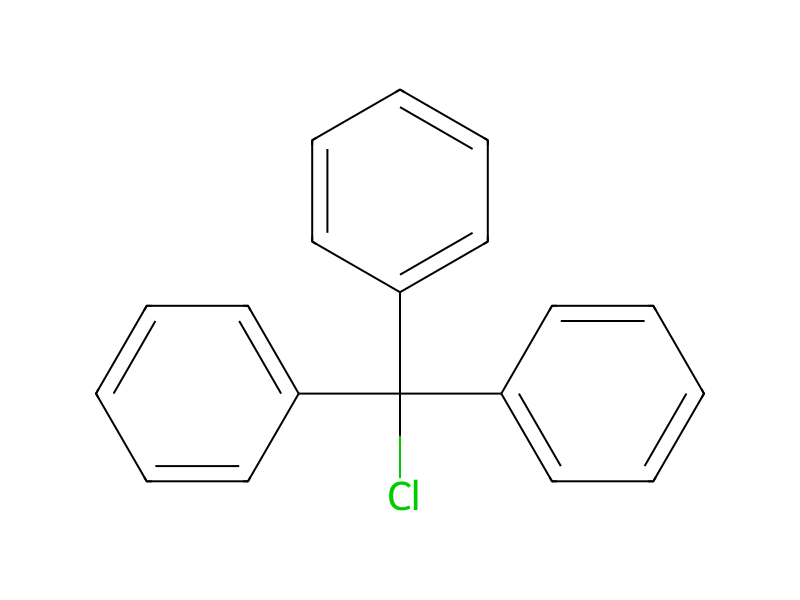

Product 1

Reagents, catalysts & solvents 1

Procedure
A solution of 3-mercapto-2-methylpropanoic acid (1.2 g.) and tritylchloride (2.9 g.) in methylene chloride (50 ml.) is kept at room temperature for 2 hours. The mixture is warmed in a steam bath for 20 minutes and then evaporated to dryness in vacuo and the residue is dissolved in saturated aqueous sodium bicarbonate and the solution is washed with ethyl acetate. The aqueous phase is acidified to pH 3 and extracted with ethyl acetate. The organic layer is dried and concentrated to dryness to give 3-triphenylmethylthio-2-methylpropanoic acid. Rf 0.8 (Silica gel, Benzene/acetic acid 3:1).
Workup
- temperatureThe mixture is warmed in a steam bath for 20 minutes
- customevaporated to dryness in vacuo
- dissolutionthe residue is dissolved in saturated aqueous sodium bicarbonate
- washthe solution is washed with ethyl acetate
- extractionextracted with ethyl acetate
- customThe organic layer is dried
- concentrationconcentrated to dryness
Sources & evidence
- ORD record
- ord-55c465f387d44d09ad5256a5226f7a73
- Source dataset
- uspto-grants-1978_08
- Patent number
- US04105776
Reaction notes
Loading…