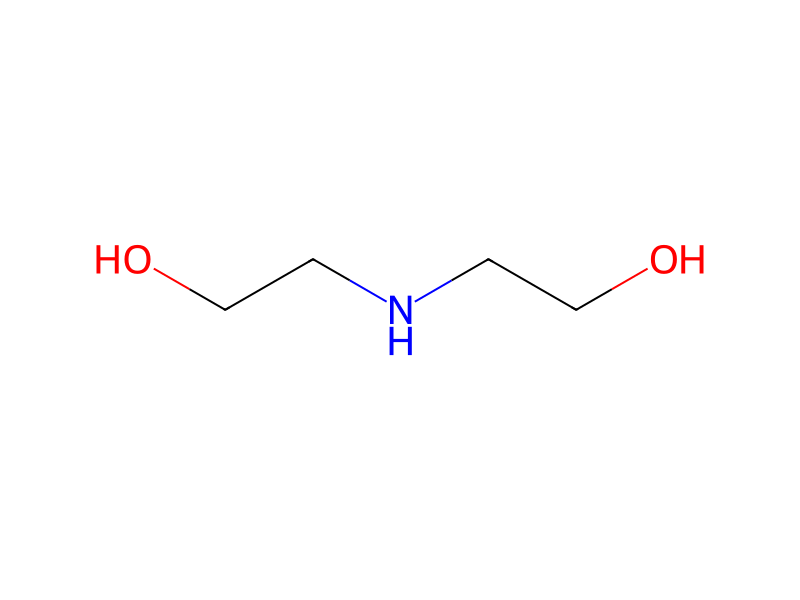
Diethanolamine → 1-[Bis(2-hydroxyethyl)amino]-4,4,4-trichlorobutan-2-ol
Reaction equation

[NH:1]([CH2:5][CH2:6][OH:7])[CH2:2][CH2:3][OH:4].[Cl:8][C:9]([Cl:15])([Cl:14])[CH2:10][CH:11]1[O:13][CH2:12]1>C(O)C>[OH:4][CH2:3][CH2:2][N:1]([CH2:12][CH:11]([OH:13])[CH2:10][C:9]([Cl:15])([Cl:14])[Cl:8])[CH2:5][CH2:6][OH:7]Participants
4
Reactant 2

Product 1

Reagents, catalysts & solvents 1

Procedure
To a solution of 52.5g (0.5 mole) diethanolamine in 100 ml ethanol heated to reflux was added 87.7g (0.5 mole) 4,4,4-trichloro-1,2-epoxybutane over a period of 105 minutes. After refluxing with agitation for an additional 5 hours the solvent was removed via vacuum leaving 135.7g (96.5%) of N,N-bis(2-hydroxyethyl)-4,4,4-trichloro-2-hydroxy-1-butylamine, a clear dark, highly viscous liquid; hydroxyl number = 600. This product is soluble in water (pH≈8) and in xylene. Analysis: (Calculated) %N, 5.00; %Cl, 37.96. (Found) %N, 5.00; %Cl, 37.09.
Workup
- temperatureto reflux
- temperatureAfter refluxing with agitation for an additional 5 hours the solvent
- customwas removed via vacuum
Sources & evidence
- ORD record
- ord-264f02555e294764bfab2961360862fe
- Source dataset
- uspto-grants-1978_08
- Patent number
- US04110379
Reaction notes
Loading…