Ethylenediamine → Ethylenediamine
Reaction equation

[CH2:1]([NH2:4])[CH2:2][NH2:3].[Cl:5][C:6]([Cl:12])([Cl:11])[CH2:7][CH:8]1[O:10][CH2:9]1.C1OC1C>C(O)(C)C.C(O)C>[CH2:1]([NH2:4])[CH2:2][NH2:3].[Cl:5][C:6]([Cl:12])([Cl:11])[CH2:7][CH:8]([OH:10])[CH3:9]Participants
Reactant 3
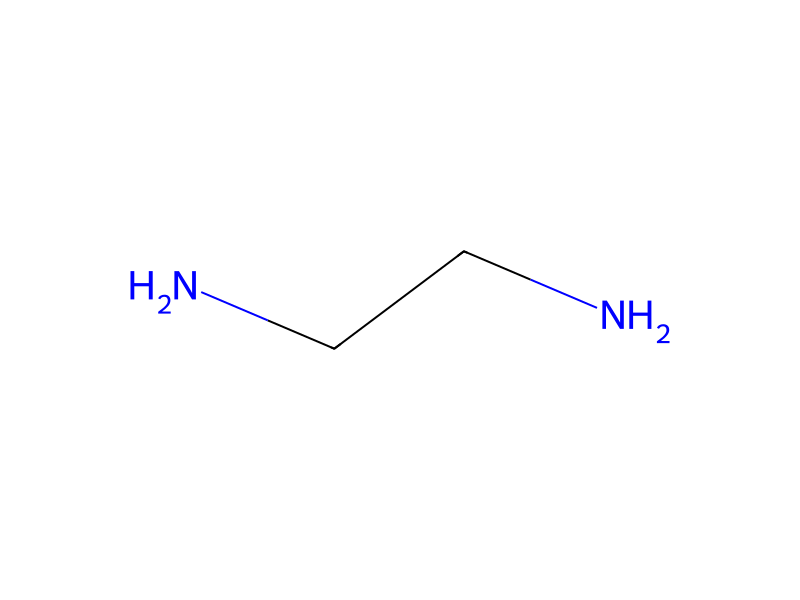


Product 2

Reagents, catalysts & solvents 2


Conditions
- Temperature
- 70 °C
Procedure
To a solution of 10.0g (0.17 mole) ethylenediamine in 100 ml isopropanol and 50 ml ethanol heated at 60° C. under nitrogen was added, dropwise, a mixture of 58.5g (0.33 mole) 4,4,4-trichloro-1,2-epoxybutane and 58.5g (1.0 mole) propylene oxide over a period of one hour. The reaction mixture was refluxed at 70° C. for one hour and an additional 17.2g (0.30 mole) of propylene oxide was then added dropwise. Refluxing with agitation was continued for an additional five hours and the mixture allowed to stand overnight. Evaporation of the solvent via vacuum afforded 74g of an addition product between ethylenediamine, 2-hydroxypropane, and 4,4,4-trichloro-2-hydroxybutane; hydroxyl number = 518. Analysis: (Calculated) %Cl, 29.52; %N, 6.47. (Found) %Cl, 29.22; %N, 6.31. On the basis of the analytical data one mole of ethylenediamine reacted with 1.2 moles 4,4,4-trichloro-1,2-epoxybutane and 2.8 moles propylene oxide.
Workup
- additionwas added
- temperatureRefluxing with agitation
- waitto stand overnight
- customEvaporation of the solvent via vacuum
Sources & evidence
- ORD record
- ord-a09e867a7e20434a96cd24479c7bc750
- Source dataset
- uspto-grants-1978_08
- Patent number
- US04110379
Reaction notes
Loading…