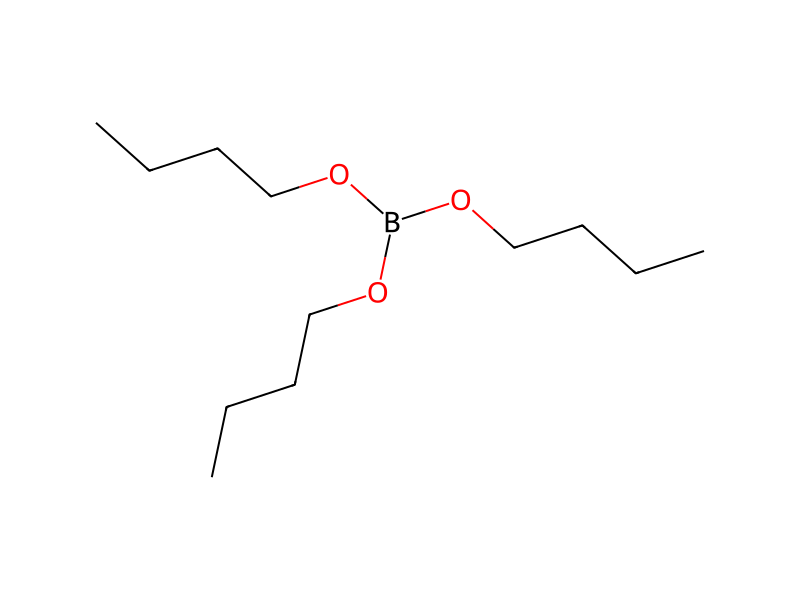
Tributyl borate → (2-ethyl-4-methoxyphenyl)boronic acid
Reaction equation

Br[C:2]1[CH:7]=[CH:6][C:5]([O:8][CH3:9])=[CH:4][C:3]=1[CH2:10][CH3:11].C([Li])CCC.[B:17](OCCCC)([O:23]CCCC)[O:18]CCCC>C1COCC1>[CH2:10]([C:3]1[CH:4]=[C:5]([O:8][CH3:9])[CH:6]=[CH:7][C:2]=1[B:17]([OH:23])[OH:18])[CH3:11]Participants
5
Reactant 3


Product 1

Reagents, catalysts & solvents 1

Conditions
- Temperature
- 0 °C
Procedure
A solution of 4-bromo-3-ethyl anisole (94 g, 0.437 mol) in THF (900 ml) was cooled to −78° C. n-Butyl lithium (249 ml, 0.55 mol) was added dropwise at the same temperature. Stirring was continued for 1 hr at −78° C. Tri-n-butyl borate (177 ml, 0.655 mol) was added slowly at −78° C. The cooling bath was removed, the reaction mixture was allowed to warm to 0° C. and was quenched with 1.5 N hydrochloric acid at 0° C. The organic layer was separated. The aqueous layer was extracted with ethylacetate and the combined organic layers were washed with brine and concentrated. The residue obtained was stirred in petroleum ether for 30 min. The solid obtained was filtered and dried under vacuum. Yield: 65 g, 82%, as a white solid.
Workup
- additionwas added dropwise at the same temperature
- customThe cooling bath was removed
- customwas quenched with 1.5 N hydrochloric acid at 0° C
- customThe organic layer was separated
- extractionThe aqueous layer was extracted with ethylacetate
- washthe combined organic layers were washed with brine
- concentrationconcentrated
- customThe residue obtained
- customThe solid obtained
- filtrationwas filtered
- customdried under vacuum
Sources & evidence
- ORD record
- ord-79297b6526e8447bbf326fd1a6530edc
- Source dataset
- uspto-grants-2011_06
- Patent number
- US07960349B2
Reaction notes
Loading…