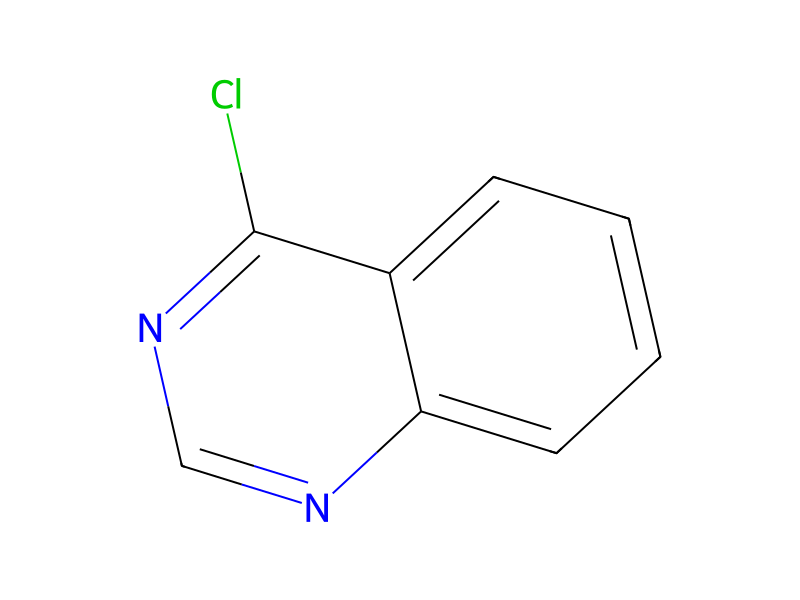
Oxalyl chloride → 4-Chloroquinazoline
Reaction equation

[N:1]1[C:10]2[C:5](=[CH:6][CH:7]=[CH:8][CH:9]=2)[C:4](=O)[NH:3][CH:2]=1.C(Cl)(=O)C([Cl:15])=O>>[Cl:15][C:4]1[C:5]2[C:10](=[CH:9][CH:8]=[CH:7][CH:6]=2)[N:1]=[CH:2][N:3]=1Participants


Procedure
The process for the preparation of Erlotinib disclosed in WO 96/30347 is shown in Scheme-1. The starting material Ethyl-3,4-dihydroxy benzoate of formula (2) is reacted with 2-bromo ethylmethyl ether in presence of a base to obtain bis-O-alkylated compound of formula (3), which is nitrated on ortho position with nitric acid in acetic acid medium to get 2-Nitro-4,5-bis(2-methoxyethoxy)benzo ate of formula (4). The nitro compound of formula (4) on hydrogenation using platinum oxide hydrate gives the amino compound of formula (5), which further reacted with ammonium formate and formamide to get 4-quinazolone compound of formula (6). The 4-quinazolone derivative is reacted with oxalyl chloride to get 4-chloro quinazoline derivative of formula (7), which on condensation with 3-ethynylaniline gives a residue containing Erlotinib base of formula (1). The residue thus obtained is purified by flash chromatography on silica to get Erlotinib base. Then the base is converted to its hydrochloride salt.
Sources & evidence
- ORD record
- ord-429862fb3fde4ae6be4e4e187952f7e7
- Source dataset
- uspto-grants-2011_06
- Patent number
- US07960545B2
Reaction notes
Loading…