Pyridine → methyl 1-(2-isopropylphenyl)-1H-indole-3-carboxylate
Reaction equation

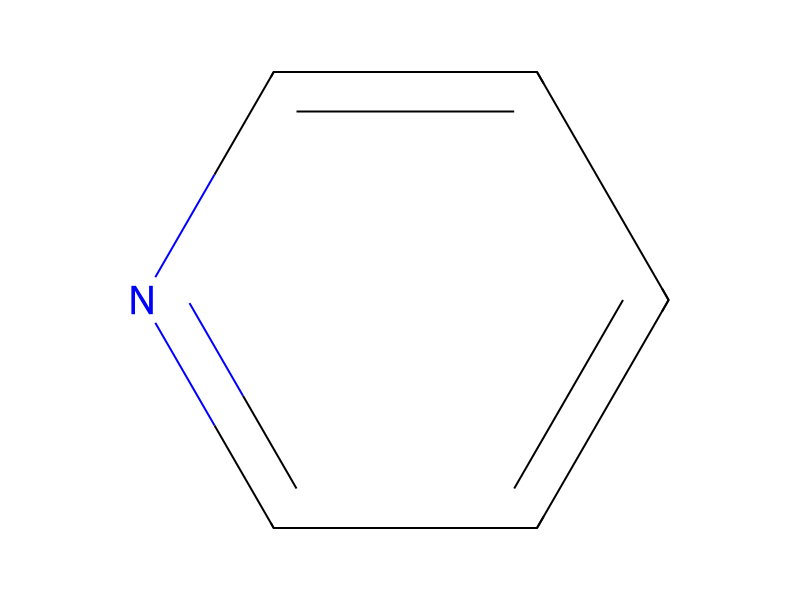
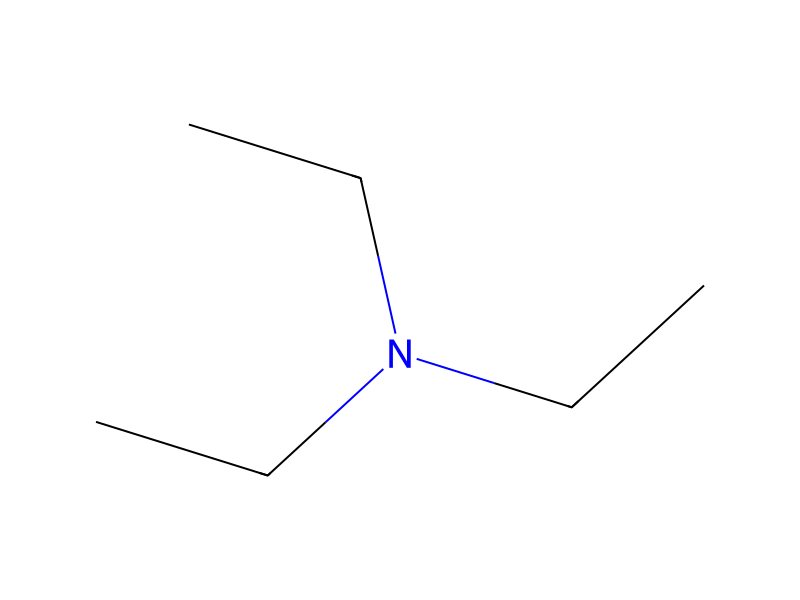
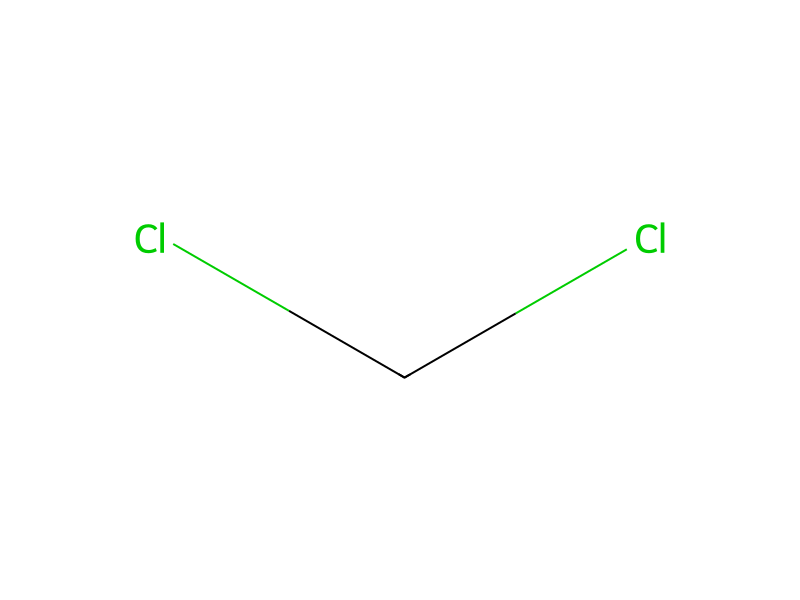
[NH:1]1[C:9]2[C:4](=[CH:5][CH:6]=[CH:7][CH:8]=2)[C:3]([C:10]([O:12][CH3:13])=[O:11])=[CH:2]1.[CH:14]([C:17]1[CH:22]=[CH:21][CH:20]=[CH:19][C:18]=1B(O)O)([CH3:16])[CH3:15].N1C=CC=CC=1.C(N(CC)CC)C>C([O-])(=O)C.[Cu+2].C([O-])(=O)C.ClCCl>[CH:14]([C:17]1[CH:22]=[CH:21][CH:20]=[CH:19][C:18]=1[N:1]1[C:9]2[C:4](=[CH:5][CH:6]=[CH:7][CH:8]=2)[C:3]([C:10]([O:12][CH3:13])=[O:11])=[CH:2]1)([CH3:16])[CH3:15]Participants
Reactant 4


Product 1

Reagents, catalysts & solvents 2

Procedure
To a screw capped vial was added methyl 1H-indole-3-carboxylate (17 mg, 0.1 mmol), 2-isopropylbenzene boronic acid (33 mg, 0.20 mmol), and activated 3 Å molecular sieves (100 mg). Anhydrous dichloromethane (1.0 mL), anhydrous pyridine (16 μL, 0.2 mmol) and anhydrous triethylamine (28 μL, 0.2 mmol) were added, the vial capped and the reaction was stirred under air for 15 min. Anhydrous copper(II) acetate was added, the vial capped, and the reaction was stirred overnight under air at 45° C. The reaction was quenched with 20 drops of methanolic ammonium hydroxide (concentrated aqueous ammonia and methanol 1:1), filtered with the aid of additional dichloromethane in order to remove the molecular sieves and the solution applied to a silica gel column for chromatography. Elution with a gradient of ethyl acetate and hexanes furnished methyl 1-(2-isopropylphenyl)-1H-indole-3-carboxylate (10 mg, 35%) as a colorless solid. To methyl 1-(2-isopropylphenyl)-1H-indole-3-carboxylate (43 mg, 0.15 mmol) was added isopropanol (2 mL) and 1 N sodium hydroxide (1 mL) and heated to 50° C. for 2 days. The solvent was removed under reduced pressure and the residue was taken up in ethyl acetate and 1 N hydrochloric acid (1:1), the phases were separated and the aqueous was extracted twice more with ethyl acetate. The combined organics were dried over sodium sulfate, filtered, and evaporated to give 1-(2-isopropylphenyl)-1H-indole-3-carboxylic acid as a straw colored solid of sufficient purity for the next step (>95% LC purity). To 1-(2-isopropylphenyl)-1H-indole-3-carboxylic acid in anhydrous dimethylformamide (2.0 mL) was added anhydrous triethylamine (104 μL, 0.75 mmol), N,N-dimethylaminopyridine (9 mg, 0.075 mmol), 4-(trifluoromethoxy)aniline (32 mg, 0.18 mmol) and stirred for 5 min followed by the addition of PyBroP® (bromotris(pyrrolidino)phosphonium hexafluorophosphate) (105 mg, 0.225 mmol). The reaction was stirred for 14 h at 40° C. The reaction was quenched into water and ethyl acetate, the phases were separated and the aqueous phase was extracted twice more with ethyl acetate. The combined organics were washed successively five times with water, once with brine, dried over sodium sulfate and evaporated to yield a residue which was purified by silica gel column chromatography eluting with a gradient of ethyl acetate and hexanes to furnish Example 50 (14 mg, 20%) as a colorless solid. LC/MS (ESI+) 439.1 (M+H)+; (ESI−) 437.2 (M−H)−. 1H NMR (400 MHz, CD3OD) δ ppm 1.08 (d, J=7.03 Hz, 3H) 1.16 (d, J=6.59 Hz, 3H) 2.51-2.63 (m, 1H) 6.93-6.97 (m, 1H) 7.19-7.32 (m, 5H) 7.37-7.42 (m, 1H) 7.53-7.62 (m, 2H) 7.78-7.82 (m, 2H) 8.12 (s, 1H) 8.28-8.32 (m, 1H).
Workup
- customTo a screw capped vial
- customthe vial capped
- stirringthe vial capped, and the reaction was stirred overnight under air at 45° C
- customThe reaction was quenched with 20 drops of methanolic ammonium hydroxide (concentrated aqueous ammonia and methanol 1:1)
- filtrationfiltered with the aid of additional dichloromethane in order
- customto remove the molecular sieves
- washElution with a gradient of ethyl acetate and hexanes
Sources & evidence
- ORD record
- ord-bdf8363ba2da440cbc7f53eec4162848
- Source dataset
- uspto-grants-2011_06
- Patent number
- US07960569B2
Reaction notes
Loading…