2-Nitropropane → 3-Chloro-5-methylbenzaldehyde
Reaction equation
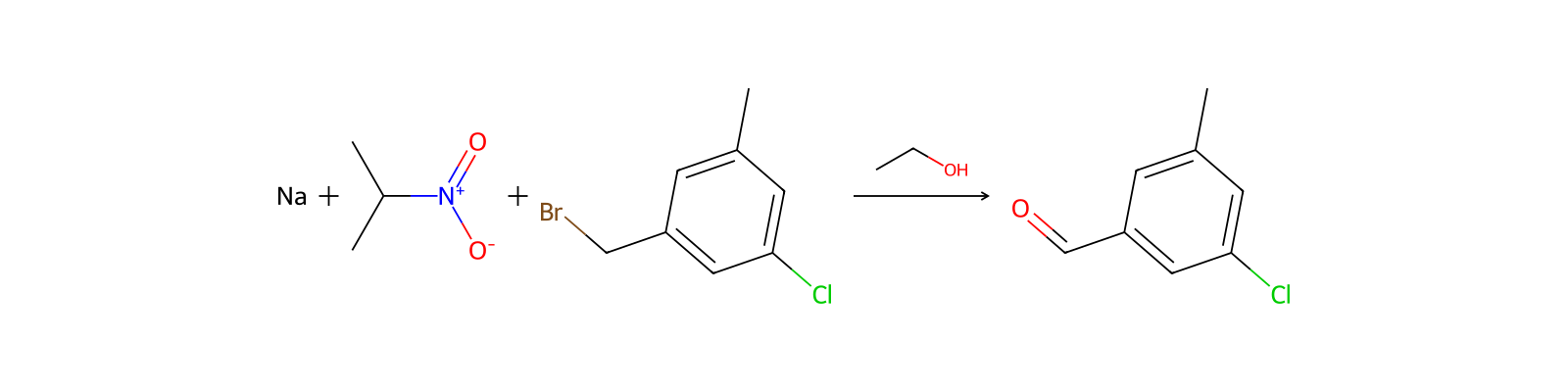
[Na].[N+](C(C)C)([O-])=[O:3].[Cl:8][C:9]1[CH:10]=[C:11]([CH:14]=[C:15]([CH3:17])[CH:16]=1)[CH2:12]Br>C(O)C>[Cl:8][C:9]1[CH:10]=[C:11]([CH:14]=[C:15]([CH3:17])[CH:16]=1)[CH:12]=[O:3]Participants
Reactant 3



Product 1

Reagents, catalysts & solvents 1

Procedure
To a solution of sodium metal (52 mg, 2.3 mmol) in ethanol was added 2-nitropropane (0.23 g, 2.4 mmole) followed by the addition of 3-chloro-5-methybenzylbromide (0.5 g, 2.3 mmol). The reaction was allowed to stir for 3 hours and the precipitate formed was filtered off. The filtrate was concentrated under reduced pressure, redissolved in diethylether and washed with 1N sodium hydroxide (twice), water, and dried over sodium sulfate, filtered and the filtrate was concentrated under reduced pressure. The resulting residue was purified via silica gel chromatography using 10% dichloromethane and 90% petroleum ether, to give 0.15 g of 3-chloro-5-methylbenzaldehyde. 1H-NMR (CDCl3): 2.46 (s, 3H) 7.43 (s, 1H) 7.56 (s, 1H) 7.68 (s, 1H), 9.92 (s, 1H).
Workup
- customthe precipitate formed
- filtrationwas filtered off
- concentrationThe filtrate was concentrated under reduced pressure
- dissolutionredissolved in diethylether
- washwashed with 1N sodium hydroxide (twice), water
- dry with materialdried over sodium sulfate
- filtrationfiltered
- concentrationthe filtrate was concentrated under reduced pressure
- customThe resulting residue was purified via silica gel chromatography
Sources & evidence
- ORD record
- ord-78ff8a329bba4cde8f31a54ba20c67ec
- Source dataset
- uspto-grants-2011_06
- Patent number
- US07964624B1
Reaction notes
Loading…