Sodium Bicarbonate → HCID 74020192, compound
Reaction equation
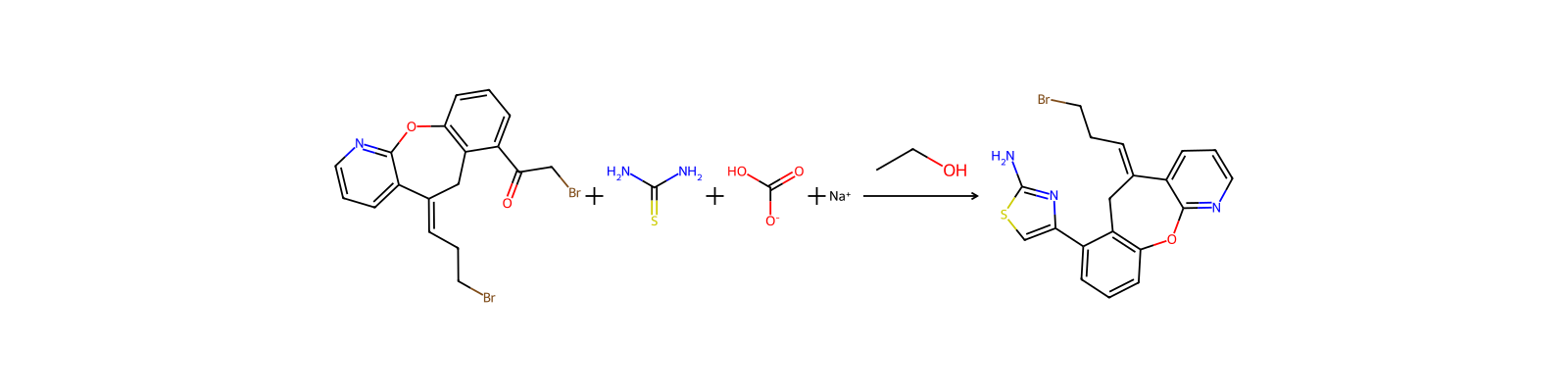
Br[CH2:2][C:3]([C:5]1[C:10]2[CH2:11][C:12](=[CH:20][CH2:21][CH2:22][Br:23])[C:13]3[C:14]([O:19][C:9]=2[CH:8]=[CH:7][CH:6]=1)=[N:15][CH:16]=[CH:17][CH:18]=3)=O.[NH2:24][C:25]([NH2:27])=[S:26].C(=O)(O)[O-].[Na+]>C(O)C>[NH2:27][C:25]1[S:26][CH:2]=[C:3]([C:5]2[C:10]3[CH2:11][C:12](=[CH:20][CH2:21][CH2:22][Br:23])[C:13]4[C:14]([O:19][C:9]=3[CH:8]=[CH:7][CH:6]=2)=[N:15][CH:16]=[CH:17][CH:18]=4)[N:24]=1Participants
5
Reactant 3



Product 1

Reagents, catalysts & solvents 1

Conditions
- Temperature
- 70 °C
Procedure
To a solution of the product of step 1 (1.1 g) in ethanol (11 ml) was added thiourea (193 mg) at room temperature, and the mixture stirred at 70° C. for 30 minutes. The reaction mixture was cooled to room temperature and poured into saturated aqueous sodiumbicarbonate. The aqueous layer was extracted with ethyl acetate, and the organic layer was washed with saturated aqueous sodium chloride, and dried with magnesium sulfate. The solvent was distilled off under reduced pressure. The residue was purified by silica gel chromatography eluting with ethyl acetate to give 7-(2-aminothiazol-4-yl)-5-(3-bromopropylidene)-5,11-dihydro[1]benzoxepino[2,3-b]pyridine (749 mg).
Workup
- temperatureThe reaction mixture was cooled to room temperature
- extractionThe aqueous layer was extracted with ethyl acetate
- washthe organic layer was washed with saturated aqueous sodium chloride
- dry with materialdried with magnesium sulfate
- distillationThe solvent was distilled off under reduced pressure
- customThe residue was purified by silica gel chromatography
- washeluting with ethyl acetate
Sources & evidence
- ORD record
- ord-367079cadff24b3797609bd21c7a6b70
- Source dataset
- uspto-grants-2014_02
- Patent number
- US08653096B2
Reaction notes
Loading…