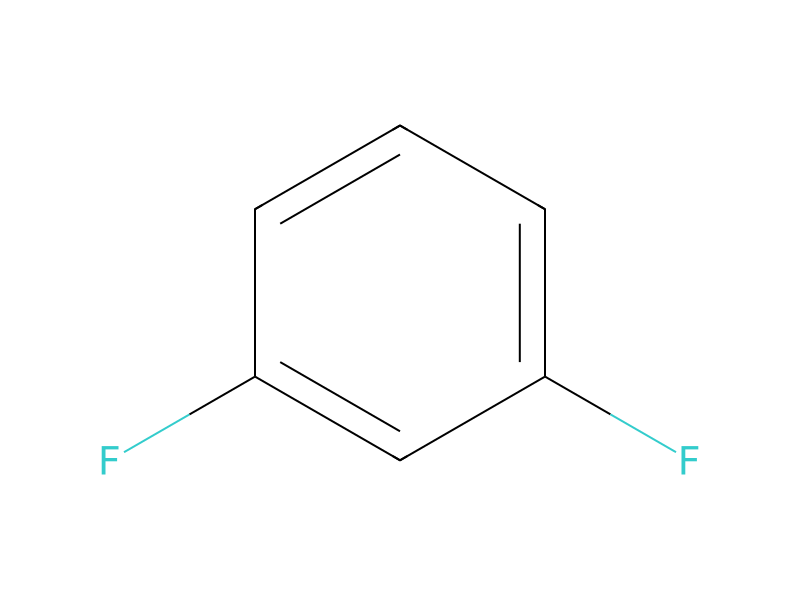
1,3-Difluorobenzene → HCID 67148212, compound
Reaction equation

C([Li])CCC.[F:6][C:7]1[CH:12]=[CH:11][CH:10]=[C:9]([F:13])[CH:8]=1.[N+:14]([C:17]1[C:24]([O:25][CH3:26])=[CH:23][CH:22]=[CH:21][C:18]=1[CH:19]=[O:20])([O-:16])=[O:15].[Cl-].[NH4+]>CCCCCC.O1CCCC1.C(OCC)C>[F:6][C:7]1[CH:12]=[CH:11][CH:10]=[C:9]([F:13])[C:8]=1[CH:19]([C:18]1[CH:21]=[CH:22][CH:23]=[C:24]([O:25][CH3:26])[C:17]=1[N+:14]([O-:16])=[O:15])[OH:20]Participants







Conditions
- Temperature
- -70 °C
Procedure
77.5 ml of a 1.6M solution of n-butyllithium (1.5 eq.) in hexane are added dropwise in order to maintain a temperature of less than or equal to −70° C. to a solution of 12.3 ml of 1,3-difluorobenzene (1.5 eq.) in 150 ml of tetrahydrofuran over 1 hour. After an additional 1 hour at −70° C., a solution of 15 g of 2-nitro-3-methoxybenzaldehyde in tetrahydrofuran is added over 1 hour still at −70° C. The reaction medium is stirred for 4 hours at −70° C. and then brought to a temperature of −5° C. over 1 hour. The reaction medium is then diluted by adding diethyl ether and then slowly hydrolyzed with a saturated aqueous solution of ammonium chloride. After decantation, the organic phase is washed with water and then dried over anhydrous sodium sulfate. The residue is chromatographed on silica gel, eluting with a dichloromethane/cyclohexane mixture (1/1) (v/v) in order to obtain 13.4 g of the expected product.
Workup
- waitbrought to a temperature of −5° C. over 1 hour
- additionThe reaction medium is then diluted
- washAfter decantation, the organic phase is washed with water
- dry with materialdried over anhydrous sodium sulfate
- customThe residue is chromatographed on silica gel
- washeluting with a dichloromethane/cyclohexane mixture (1/1) (v/v) in order
Sources & evidence
- ORD record
- ord-c2d3e1ce8c1a49cb86584afdb285a719
- Source dataset
- uspto-grants-2011_06
- Patent number
- US07968534B2
Reaction notes
Loading…