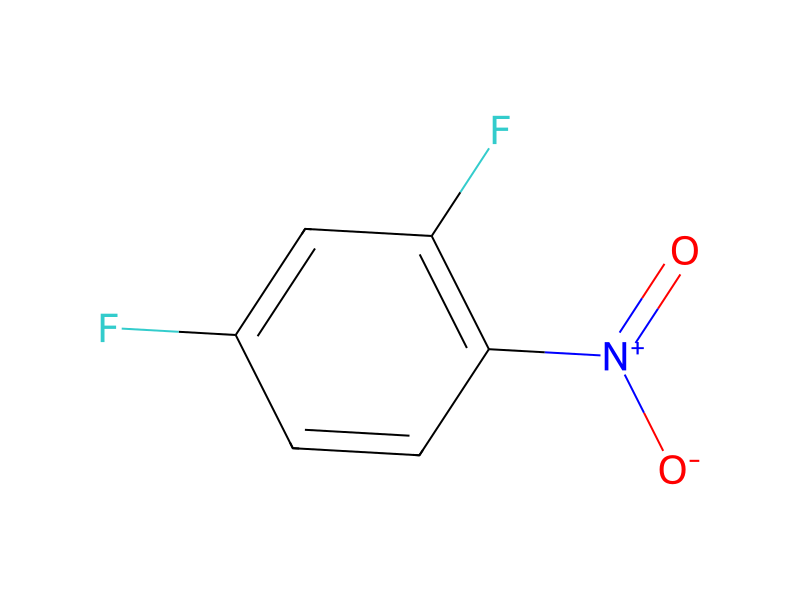
2,4-Difluoronitrobenzene → HCID 68157072, compound
Reaction equation

F[C:2]1[CH:7]=[C:6]([F:8])[CH:5]=[CH:4][C:3]=1[N+:9]([O-:11])=[O:10].[NH2:12][CH:13]1[CH2:16][CH:15]([C:17]#[N:18])[CH2:14]1.CCN(C(C)C)C(C)C>C(#N)C>[F:8][C:6]1[CH:5]=[CH:4][C:3]([N+:9]([O-:11])=[O:10])=[C:2]([NH:12][CH:13]2[CH2:16][CH:15]([C:17]#[N:18])[CH2:14]2)[CH:7]=1Participants
5
Reactant 3


Product 1

Reagents, catalysts & solvents 1

Procedure
2,4-Difluoro-1-nitrobenzene (0.38 g, 2.4 mmol), 3-aminocyclobutanecarbonitrile (0.23 g, 2.4 mmol) and then DIPEA (0.425 mL, 2.4 mmol) were added to acetonitrile (10 mL) and the resultant mixture stirred at 20° C. for 16 hours under a nitrogen atmosphere. The mixture was concentrated in vacuo and the residue was purified by silica gel chromatography (Si—PPC; eluting with ethyl acetate in cyclohexane 0-50%) to give the title compound as a yellow solid (0.38 g, 68%). 1H NMR (CDCl3) δ: 8.23 (1H, dd, J=9.2, 5.8 Hz), 8.20 (1H, br s), 6.41-6.49 (1H, m), 6.29 (1H, dd, J=11.0, 2.7 Hz), 4.30-4.43 (1H, m), 3.20-3.31 (1H, m), 2.87-2.98 (2H, m), 2.42-2.55 (2H, m)
Workup
- concentrationThe mixture was concentrated in vacuo
- customthe residue was purified by silica gel chromatography (Si—PPC; eluting with ethyl acetate in cyclohexane 0-50%)
Sources & evidence
- ORD record
- ord-0ecb3df0629a4fecba8bbf0f40230297
- Source dataset
- uspto-grants-2014_02
- Patent number
- US08653089B2
Reaction notes
Loading…