Ammonia → Ammonium dihydrogen phosphate
Reaction equation

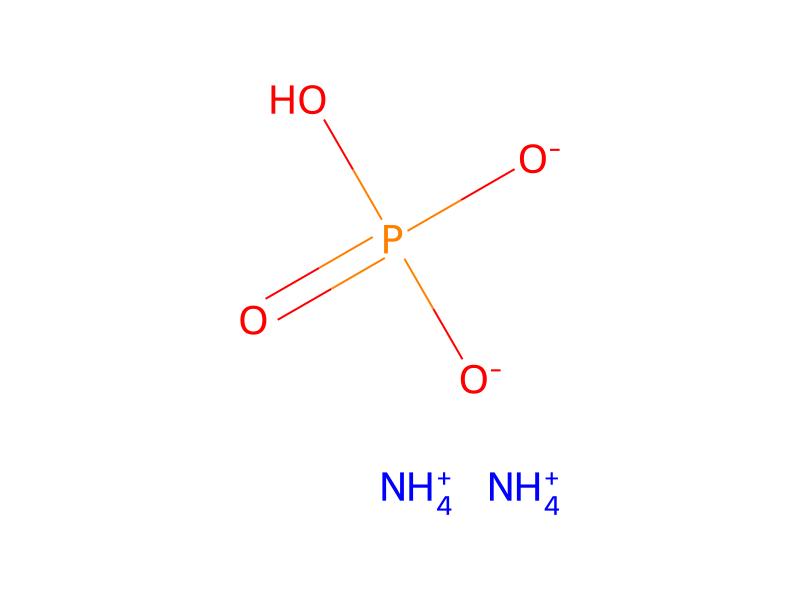
[P:1](=[O:5])([OH:4])([OH:3])[OH:2].[O:6]=[P:7]12[O:18]P3(OP(OP(O3)([O:14]1)=O)(=O)[O:8]2)=O.[NH3:20]>>[P:1]([OH:5])([OH:4])([O-:3])=[O:2].[NH4+:20].[P:7]([OH:18])([O-:14])([O-:8])=[O:6].[NH4+:20].[NH4+:20]Participants


Procedure
All ammonium phosphate salts are derived from phosphoric acid. Merchant-grade phosphoric acid, having a concentration of about 54% P2O5, is neutralized with ammonia to form either mono-ammonium phosphate (MAP) or di-ammonium phosphate (DAP) by controlling the ammonia to phosphoric acid mole ratio during the neutralization process. Ammonia is used in liquid or gaseous form. Liquid anhydrous ammonia is usually preferred since surplus heat from other systems is necessary for vaporizing liquid ammonia into a gaseous form. The neutralization of merchant-grade phosphoric acid with ammonia is usually performed in several stages using several reaction vessels. The mole ratio of ammonia to phosphoric acid in the pre-reactor/s is normally held at a level which gives the maximum solubility for the slurry (between 1.4 and 1.45 for production of DAP and usually less than 1 for production of MAP). For operation control, the ammonia to phosphoric acid mole ratio is determined by monitoring the pH of the slurry. Excess heat of reaction is removed from the pre-neutralizer/s by adding water to the reactor/s. Evaporation of the water cools the slurry. As the mole ratio of ammonia to phosphoric acid is increased over 1, un-reacted ammonia escapes from the reactor and the gaseous vapors released must be scrubbed with an acid. The slurry from the pre-neutralization reactor/s which usually contain between 16 to 23% water is usually fed into an ammoniator-granulator to complete the addition of ammonia for the desired product. Completion of the neutralization and additional evaporation of water results in solid particles being formed. It is necessary to recover the un-reacted ammonia from the gaseous vapors by scrubbing with an acid. Thereafter, the solid ammonium phosphates are usually dried in a separate reactor to reduce moisture content. Loss of ammonia from the dryer is usually recovered by scrubbing with acid. The solid ammonium phosphates are normally cooled by passing air through a cooling reactor.
Sources & evidence
- ORD record
- ord-e65529a2a5784ae88d6513b024b01780
- Source dataset
- uspto-grants-2014_02
- Patent number
- US08658117B2
Reaction notes
Loading…