Ethylenediamine → N1,N1,N2,N2-Tetrabutyl-1,2-ethanediamine
Reaction equation

[CH2:1]([NH2:4])[CH2:2][NH2:3].Cl[CH2:6][CH2:7][CH2:8][CH3:9]>>[CH2:6]([N:3]([CH2:6][CH2:7][CH2:8][CH3:9])[CH2:2][CH2:1][N:4]([CH2:6][CH2:7][CH2:8][CH3:9])[CH2:6][CH2:7][CH2:8][CH3:9])[CH2:7][CH2:8][CH3:9]Participants
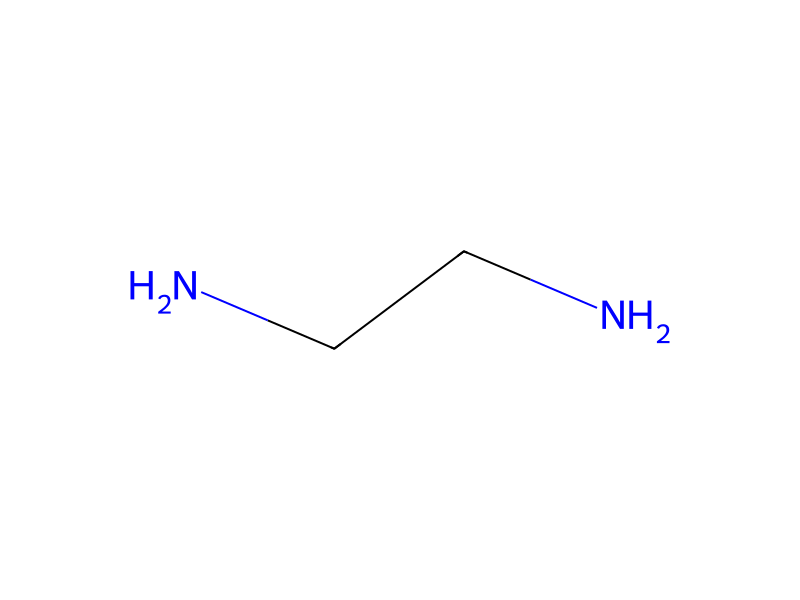


Procedure
A three-necked round-bottomed flask (3 L) equipped with a Friedrich's condenser and an overhead mechanical stirrer is placed in a cooling bath. The flask is charged with dimethylformamide (DMF, 500 mL), potassium carbonate (2.1 mol), and potassium iodide (0.1 mol). The mixture is allowed to stir until the potassium iodide was dissolved (giving a faint yellow tint) and the potassium carbonate was fairly homogenized. Ethylenediamine (0.5 mol) is then added to the reaction mixture. 1-Chlorobutane (2.2 mol) is added drop-wise to the resulting reaction mixture from a pressure-equalizing addition funnel under efficient mechanical stirring. During the addition of the alkyl halide, the exothermic reaction which may occur is controlled by cooling the round-bottomed flask bath with the cooling bath so as to maintain the reaction temperature below room temperature (e.g., using a chiller temperature ˜5° C.). After all the alkyl halide has been added and any exotherm subsides, the cooling bath is replaced by a heating mantle or oil bath. The reaction mixture is then heated (˜50° C. reaction temperature; ˜70-80° C. bath temperature) under efficient stirring. After heating overnight, the reaction set-up is modified for vacuum distillation and unreacted alkyl halide and a majority of the DMF (about 400-450 mL) is removed. The resulting residual mixture in the reaction flask is partitioned between water and ethyl acetate in a separatory funnel to separate the polyalkylated product from the inorganic salts. The aqueous fraction is extracted three times with ethyl acetate and the combined ethyl acetate solutions are sequentially washed with water and brine solution. The ethyl acetate extract is dried over sodium sulfate, filtered and concentrated using a rotary evaporator. The resulting oily residue can be distilled under reduced pressure to isolate a purified fraction of tetrabutylethylenediamine.
Workup
- customto the resulting reaction mixture
- additionfrom a pressure-equalizing addition funnel under efficient mechanical stirring
- customthe exothermic reaction which
- temperatureby cooling the round-bottomed flask bath with the cooling bath so as
- temperatureto maintain the reaction temperature below room temperature (e.g.
- customa chiller temperature ˜5° C.
- temperatureThe reaction mixture is then heated
- custom(˜50° C. reaction temperature; ˜70-80° C. bath temperature) under efficient stirring
- temperatureAfter heating overnight
- distillationthe reaction set-up is modified for vacuum distillation and unreacted alkyl halide
- customa majority of the DMF (about 400-450 mL) is removed
- customThe resulting residual mixture in the reaction flask is partitioned between water and ethyl acetate in a separatory funnel
- customto separate the polyalkylated product from the inorganic salts
- extractionThe aqueous fraction is extracted three times with ethyl acetate
- washthe combined ethyl acetate solutions are sequentially washed with water and brine solution
- extractionThe ethyl acetate extract
- dry with materialis dried over sodium sulfate
- filtrationfiltered
- concentrationconcentrated
- customa rotary evaporator
- distillationThe resulting oily residue can be distilled under reduced pressure
Sources & evidence
- ORD record
- ord-bc97d6f2554a4b1aa55d14d73add0705
- Source dataset
- uspto-grants-2014_02
- Patent number
- US08658829B2
Reaction notes
Loading…