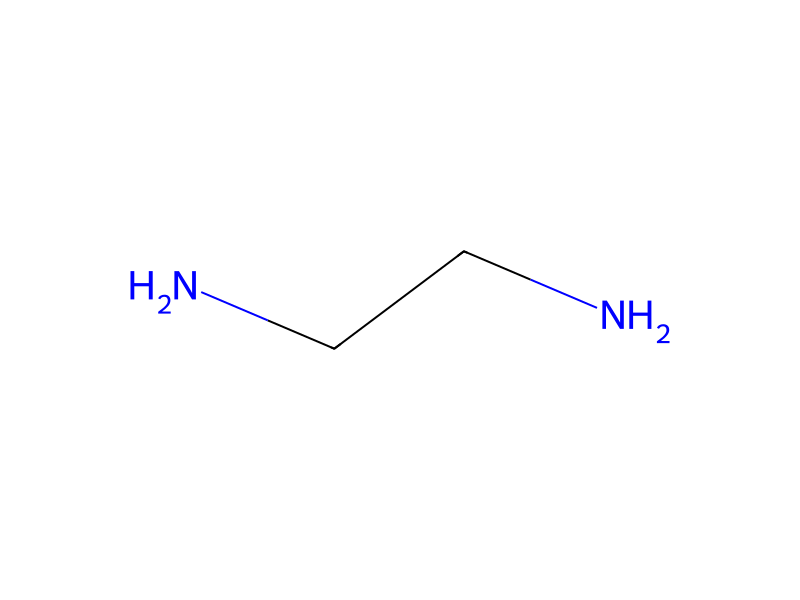
Ethylenediamine → 2-(1H-indol-7-yl)-5H-pyrrolo[2,3-b]pyrazine-7-carboxamide
Reaction equation

C([NH:5][C:6]([C:8]1[C:16]2[C:11](=[N:12][CH:13]=[C:14]([C:17]3[CH:18]=[CH:19][CH:20]=[C:21]4[C:25]=3[NH:24][CH:23]=[CH:22]4)[N:15]=2)[N:10](COCC[Si](C)(C)C)[CH:9]=1)=[O:7])(C)(C)C.C(N)CN>CN(C=O)C.O>[NH:24]1[C:25]2[C:21](=[CH:20][CH:19]=[CH:18][C:17]=2[C:14]2[N:15]=[C:16]3[C:8]([C:6]([NH2:5])=[O:7])=[CH:9][NH:10][C:11]3=[N:12][CH:13]=2)[CH:22]=[CH:23]1Participants
Reactant 2

Product 1

Reagents, catalysts & solvents 2


Conditions
- Temperature
- 60 °C
Procedure
To a stirred solution of N-tert-butyl-2-(1H-indol-7-yl)-5-((2-(trimethylsilyl)ethoxy)methyl)-5H-pyrrolo[2,3-b]pyrazine-7-carboxamide (54 mg, 116 μmol) in DMF (3 mL) was added ethylenediamine (350 mg, 393 μL, 5.82 mmol) and the mixture heated at 60° C. After 72 h, the reaction mixture was cooled, diluted with water, and extracted into ethyl acetate. The organic phases were combined and washed with water and brine then dried (MgSO4), filtered and concentrated in vacuo. The residue was triturated with ether, then water, diluted with dichloromethane, and finally the solvents removed in vacuo to give N-tert-butyl-2-(2-(1H-indol-7-yl)-5H-pyrrolo[2,3-b]pyrazine-7-carboxamide (14 mg). MS (M+H)+=334.1; 1H NMR (DMSO-d6) δ: 12.83 (br. s., 1H), 11.46 (br. s., 1H), 9.01 (s, 1H), 8.49 (s, 1H), 8.24 (s, 1H), 7.81 (d, J=7.8 Hz, 1H), 7.73 (d, J=7.5 Hz, 1H), 7.52 (br. s., 1H), 7.30 (t, J=7.5 Hz, 1H), 6.69 (br. s., 1H), 1.55 (s, 9H).
Workup
- temperaturethe reaction mixture was cooled
- extractionextracted into ethyl acetate
- washwashed with water and brine
- dry with materialthen dried (MgSO4)
- filtrationfiltered
- concentrationconcentrated in vacuo
- customThe residue was triturated with ether
- additionwater, diluted with dichloromethane
- customfinally the solvents removed in vacuo
Sources & evidence
- ORD record
- ord-29749230fc9e4587bbc5ac0079aff843
- Source dataset
- uspto-grants-2014_02
- Patent number
- US08658646B2
Reaction notes
Loading…