Water → 4-Ethenylphenyl acetate
Reaction equation

O.C(O[CH2:6][CH2:7][C:8]1[CH:13]=[CH:12][C:11]([O:14][C:15](=[O:17])[CH3:16])=[CH:10][CH:9]=1)(=O)C.C(OC(=O)C)(=O)C.P(=O)(O)(O)O>C(O)(=O)C>[C:15]([O:14][C:11]1[CH:12]=[CH:13][C:8]([CH:7]=[CH2:6])=[CH:9][CH:10]=1)(=[O:17])[CH3:16]Participants
Reactant 4




Product 1
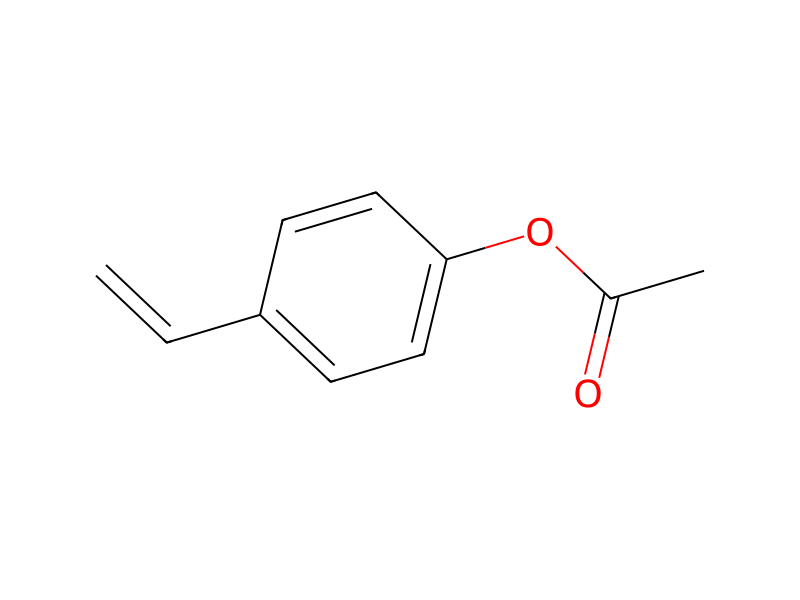
Reagents, catalysts & solvents 1

Procedure
A flask heated by hot oil was fitted with a chilled water overhead condenser, a thermowell with a thermocouple, an overhead stirrer and a vacuum pump. Crude APMC-Ether (20 grams) containing 78.2 weight percent APMC-Ether, 7.2 weight percent APMC and 3.9 weight percent 4-acetoxyphenylmethylcarbinol acetate (sometimes referred to herein as "APMC-Acetate") was mixed in another flask with six (6.0) grams of acetic anhydride. Phosphoric acid (0.022 grams) having a concentration of 85 weight percent that corresponds to 0.32 moles of pure phosphoric acid per 100 moles of APMC-Ether was added to said mixture. The resultant mixture was fed to the hot flask at a rate of 1.2 grams per minute. The hot oil temperature was maintained at about 220° C. to about 230° C. and the reaction mass temperature in the hot flask was maintained at about 180° C. to about 200° C. The vacuum pump maintained a vacuum in the flask at about 80 mm Hg. 4-acetoxystyrene and acetic acid were produced in the hot flask.
Workup
- temperatureA flask heated by hot oil
- additionwas added
- temperatureThe hot oil temperature was maintained at about 220° C. to about 230° C.
- temperaturethe reaction mass temperature in the hot flask was maintained at about 180° C. to about 200° C
- temperatureThe vacuum pump maintained a vacuum in the flask at about 80 mm Hg
Sources & evidence
- ORD record
- ord-14312ca10d074038b708283d34a8e10b
- Source dataset
- uspto-grants-1993_05
- Patent number
- US05210278
Reaction notes
Loading…