Phosphorus oxychloride → 5,6-Dichloro-2-cyclopropylpyrimidine-4-carboxylic acid
Reaction equation
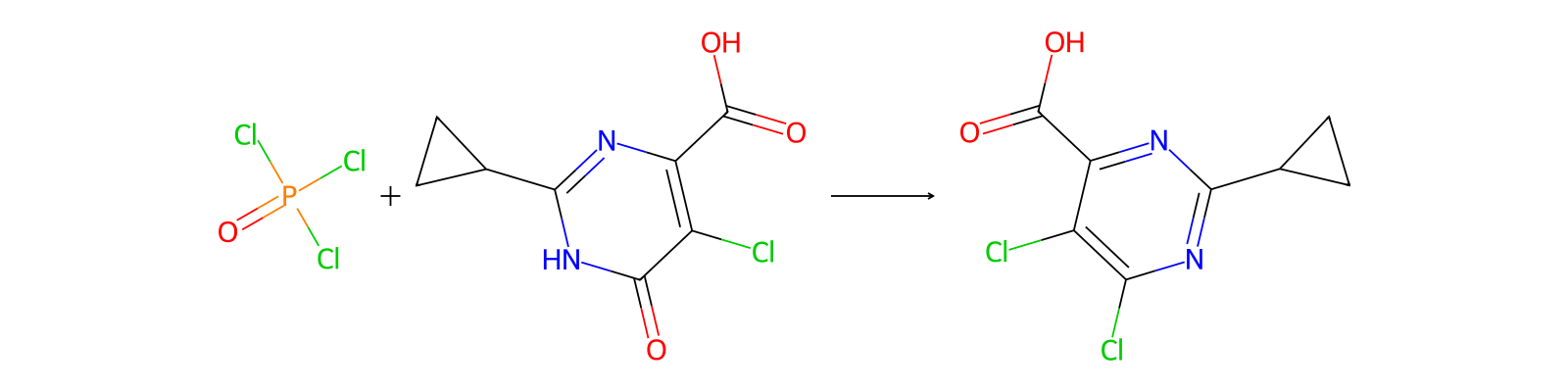
P(Cl)(Cl)([Cl:3])=O.[Cl:6][C:7]1[C:12](=O)[NH:11][C:10]([CH:14]2[CH2:16][CH2:15]2)=[N:9][C:8]=1[C:17]([OH:19])=[O:18]>>[Cl:6][C:7]1[C:8]([C:17]([OH:19])=[O:18])=[N:9][C:10]([CH:14]2[CH2:16][CH2:15]2)=[N:11][C:12]=1[Cl:3]Participants



Conditions
- Temperature
- 90 °C
Procedure
Phosphorus oxychloride (200 mL, 328 g, 2.14 mol) and 5-chloro-2-cyclopropyl-1,6-dihydro-6-oxo-4-pyrimidinecarboxylic acid (i.e. the product of Step B1 or B2) (96.8 g, 451 mmol) were combined and heated at 90° C. for 5 h. The reaction mixture was cooled to 50-60° C. and concentrated at reduced pressure to half volume. After cooling to 30° C. the reaction mixture was added over 60 minutes to a mixture of t-butanol (200 mL) and water (300 mL), with the temperature maintained at 8-10° C. The mixture was seeded, water (300 mL) was added gradually at 10-15° C. and the mixture was stirred for 1 h. After cooling to 5° C. the precipitated product was isolated by filtration and washed with water (3×50 mL). The solid was dried in a vacuum oven to afford the title compound (93 g).
Workup
- temperatureThe reaction mixture was cooled to 50-60° C.
- concentrationconcentrated at reduced pressure to half volume
- temperatureAfter cooling to 30° C. the reaction mixture
- additionwas added over 60 minutes to a mixture of t-butanol (200 mL) and water (300 mL), with the temperature
- temperaturemaintained at 8-10° C
- additionwater (300 mL) was added gradually at 10-15° C.
- temperatureAfter cooling to 5° C. the precipitated product
- customwas isolated by filtration
- washwashed with water (3×50 mL)
- customThe solid was dried in a vacuum oven
Sources & evidence
- ORD record
- ord-cfdf4184cd4940c4b595f49faebd3e9a
- Source dataset
- uspto-grants-2011_01
- Patent number
- US07863220B2
Reaction notes
Loading…