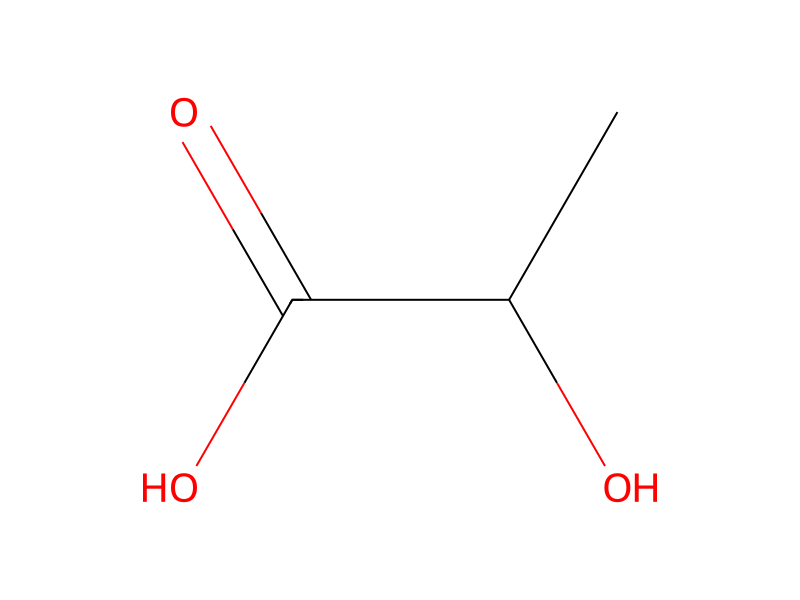
Lactic Acid → Lactic Acid
Reaction equation

[C:1]([OH:6])(=[O:5])[CH:2]([CH3:4])[OH:3].[OH2:7]>>[C:1]([OH:6])(=[O:5])[CH:2]([CH3:4])[OH:3].[O:7]=[CH:4][C@@H:2]([C@H:1]([C@@H:4]([C@@H:2]([CH2:1][OH:6])[OH:3])[OH:7])[OH:6])[OH:3]Participants


Procedure
Of such biodegradable plastics, PLA (poly lactic acid) is a polymer of the low molecular compound (monomer), called lactic acid, present in the living organisms, and has been known that it is converted into the low molecular compound by hydrolysis with water and then, decomposed with microbes. Poly lactic acid fibers are prepared according to the process which comprises fermenting corn starch to produce lactic acid via glucose and then condensing lactic acid to prepare PLA, which is then subjected to melt spinning or melt molding procedure together with polyesters or nylons. Corn is composed of starch, gluten, husk, hull and fiber, and germ, with starch accounting for 65%, which is converted into lactic acid through fermentation. In this case, the optical isomer in which L-form of lactic acid constitutes the main part and D-form is also present is produced. Cargill Inc. in USA has developed the raw material of PLA (NatureWorks PLA) and supplied under the trademark “Ingeo”. Also, three to four Japanese companies and Novament of Intaly have also developed and practically implemented PLA materials. It has been known that PLA has the molecular structure of H—(OCH(CH3)CO)n-OH and the melting point of about 175° C. Therefore, it dose not burn at high temperature of the process for manufacturing the vegetation basis of the present invention and remains in the artificial soil to keep the framework of the basis. Although general corn starch fibers can also be used, the sheath-core type corn starch fibers were also marketed and therefore, such commercialized product can be purchased and used. They can be prepared so that the sheath component has a low-melting point (e.g. 130-140° C.) and the core component has a high-melting point (e.g. 160-170° C.). The sheath-core type corn starch fibers provides the effects identical to those of using said sheath-core type polyester fibers, and thus, forms sufficient pores in the artificial soil and also allows the soil structure to have a strong solidarity.
Sources & evidence
- ORD record
- ord-d0ccfb35f42646549439c57b618eaeb4
- Source dataset
- uspto-grants-2011_01
- Patent number
- US07868057B2
Reaction notes
Loading…