Ammonium formate → 1-(5-hydroxy-1H-indazol-1-yl)-Ethanone
Reaction equation

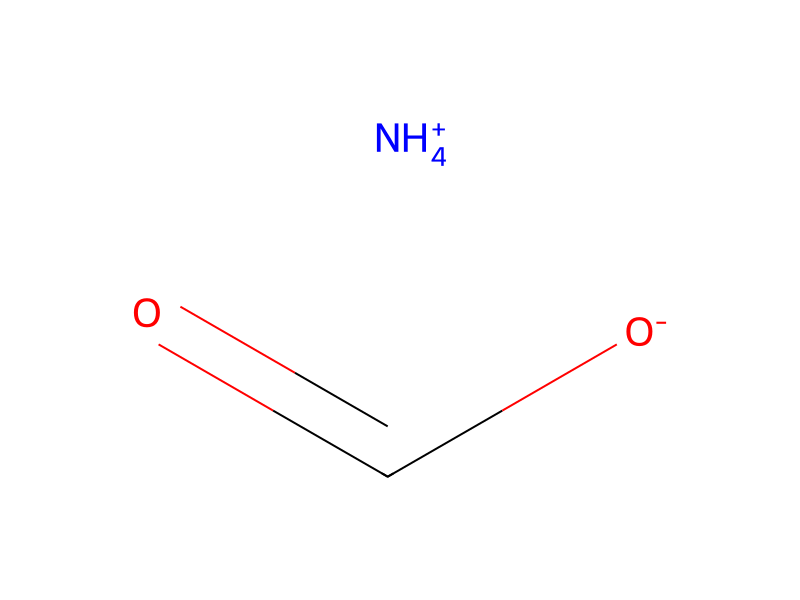
[C:1]([N:4]1[C:12]2[C:7](=[CH:8][C:9]([O:13]CC3C=CC=CC=3)=[CH:10][CH:11]=2)[CH:6]=[N:5]1)(=[O:3])[CH3:2].C([O-])=O.[NH4+]>[Pd].CC(C)=O>[C:1]([N:4]1[C:12]2[C:7](=[CH:8][C:9]([OH:13])=[CH:10][CH:11]=2)[CH:6]=[N:5]1)(=[O:3])[CH3:2]Participants
Reactant 2

Product 1

Reagents, catalysts & solvents 2


Procedure
1-Acetyl-5-hydroxy-1H-indazole can be obtained in the following way: a suspension of 467 mg of 1-acetyl-5-benzyloxy-1H-indazole, 525 mg of ammonium formate, 1 g of 10% palladium-on-charcoal and 50 ml of acetone is brought to reflux for 3 hours. After returning to a temperature in the region of 20° C., the reaction medium is filtered through a bed of Celite 535. The filtrate is concentrated by evaporation under reduced pressure and the oil obtained is purified by chromatography on a silica column with a dichloromethane/methanol (98/2 by volume) mixture as eluent. 132 mg of 1-acetyl-5-hydroxy-1H-indazole are thus obtained in the form of a white solid (Rf=0.32, silica gel thin layer chromatography, eluent: methanol/dichloromethane (2/98 by volume)).
Workup
- temperatureto reflux for 3 hours
- customAfter returning to a temperature in the region of 20° C.
- filtrationthe reaction medium is filtered through a bed of Celite 535
- concentrationThe filtrate is concentrated by evaporation under reduced pressure
- customthe oil obtained
- customis purified by chromatography on a silica column with a dichloromethane/methanol (98/2 by volume) mixture as eluent
Sources & evidence
- ORD record
- ord-fbe5d9e44e3c412491fa32187b0c0d94
- Source dataset
- uspto-grants-2005_02
- Patent number
- US06858638B2
Reaction notes
Loading…