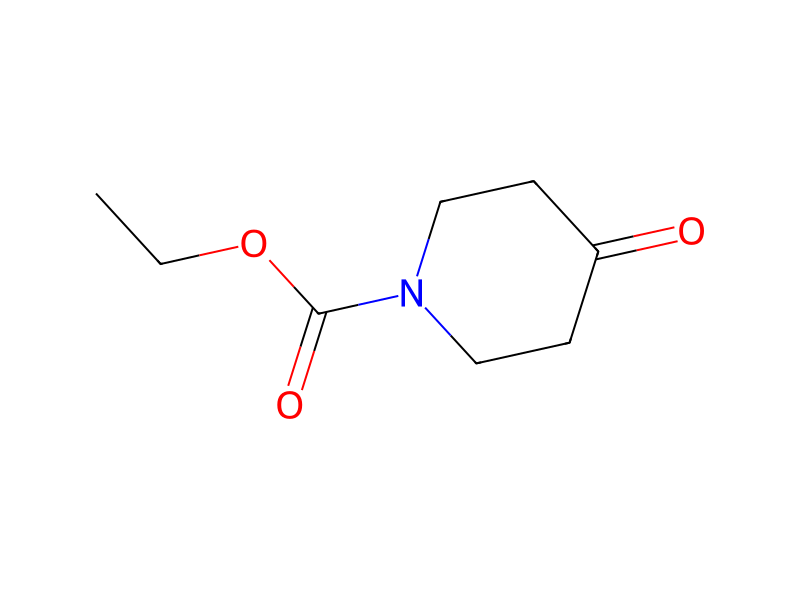
Ethyl 4-oxo-1-piperidinecarboxylate → Ethyl 8-fluoro-1,3,4,5-tetrahydro-2H-pyrido[4,3-b]indole-2-carboxylate
Reaction equation

C1C(C(O)CCCN2CC3C4C=C(F)C=CC=4N(C4C=CC(F)=CC=4)C=3CC2)=CC=C(F)C=1.[F:34][C:35]1[CH:40]=[CH:39][C:38]([NH:41]N)=[CH:37][CH:36]=1.[C:43]([N:48]1[CH2:53][CH2:52][C:51](=O)[CH2:50][CH2:49]1)([O:45][CH2:46][CH3:47])=[O:44]>>[F:34][C:35]1[CH:40]=[CH:39][C:38]2[NH:41][C:51]3[CH2:52][CH2:53][N:48]([C:43]([O:45][CH2:46][CH3:47])=[O:44])[CH2:49][C:50]=3[C:37]=2[CH:36]=1Participants
4


Procedure
Plattner et al. and Harbert et al. also describe the earliest synthesis of flutroline: p-Fluorophenylhydrazine is condensed with N-carbethoxy-4-piperidone to form 8-fluoro-2-carbethoxy-2,3,4,5-tetrahydro-1H-pyrido[4,3-b]indole. By the Ullman reaction the latter is arylated to form the 5-(p-fluorophenyl) derivative and then hydrolyzed under vigorous basic conditions to yield 8-fluoro-5-(p-fluorophenyl)-2,3,4,5-tetrahydro-1H-pyrido[4,3-b]indole. The synthesis of flutroline is completed by 2-alkylation with 3-(p-fluorobenzoyl)propyl chloride and finally reduction of the ketone group to an alcohol group.
Sources & evidence
- ORD record
- ord-1960b51f9e6d466e81f9c0df7d158d0d
- Source dataset
- uspto-grants-1987_10
- Patent number
- US04698444
Reaction notes
Loading…