Triethylamine → Ethyl 3-dimethylamino-2-(2,4-dichloro-5-fluorobenzoyl)acrylate
Reaction equation

[CH3:1][N:2]([CH3:10])[CH:3]=[CH:4][C:5]([O:7][CH2:8][CH3:9])=[O:6].C(N(CC)CC)C.[Cl:18][C:19]1[CH:27]=[C:26]([Cl:28])[C:25]([F:29])=[CH:24][C:20]=1[C:21](Cl)=[O:22]>O1CCOCC1>[CH3:1][N:2]([CH3:10])[CH:3]=[C:4]([C:21](=[O:22])[C:20]1[CH:24]=[C:25]([F:29])[C:26]([Cl:28])=[CH:27][C:19]=1[Cl:18])[C:5]([O:7][CH2:8][CH3:9])=[O:6]Participants

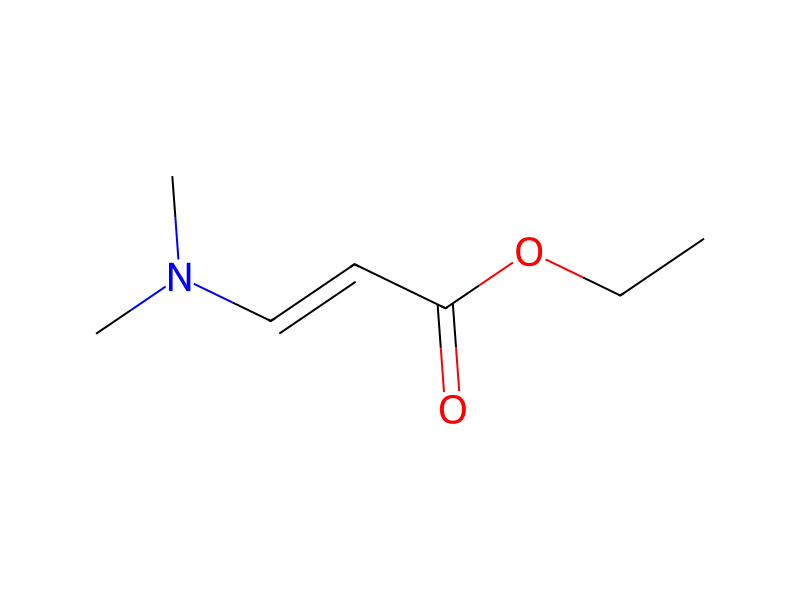



Procedure
14.3 g of ethyl 3-dimethylaminoacrylate and 10.5 g of triethylamine are added dropwise to a solution of 22.75 g of 2,4-dichloro-5-fluorobenzoyl chloride in 100 ml of anhydrous dioxane at 10° to 20° C., with stirring. The mixture is stirred at room temperature for 3 hours, heated at 40°-50° C. for 1 hour, and the solvent is removed by distillation in vacuo and the residue is taken up in methylene chloride/H2O. The phases are separated, and the aqueous solution is again extracted with methylene chloride. The CH2Cl2 solution is washed with water, dried with sodium sulphate, and the solvent is removed in vacuo. The crystalline residue is recrystallized from cyclohexane/light petroleum. 27.8 g of ethyl 3-dimethylamino-2-(2,4-dichloro-5-fluorobenzoyl)acrylate of melting point 94°-95° C. are obtained.
Workup
- stirringThe mixture is stirred at room temperature for 3 hours
- temperatureheated at 40°-50° C. for 1 hour
- customthe solvent is removed by distillation in vacuo
- customThe phases are separated
- extractionthe aqueous solution is again extracted with methylene chloride
- washThe CH2Cl2 solution is washed with water
- dry with materialdried with sodium sulphate
- customthe solvent is removed in vacuo
- customThe crystalline residue is recrystallized from cyclohexane/light petroleum
Sources & evidence
- ORD record
- ord-ff1efb9d82af45a6a07d4ff1ecd9414a
- Source dataset
- uspto-grants-1987_10
- Patent number
- US04699992
Reaction notes
Loading…