Hydrochloric Acid → 2-Chloro-4-hydroxymethyl-3,5,6-trifluoropyridine
Reaction equation

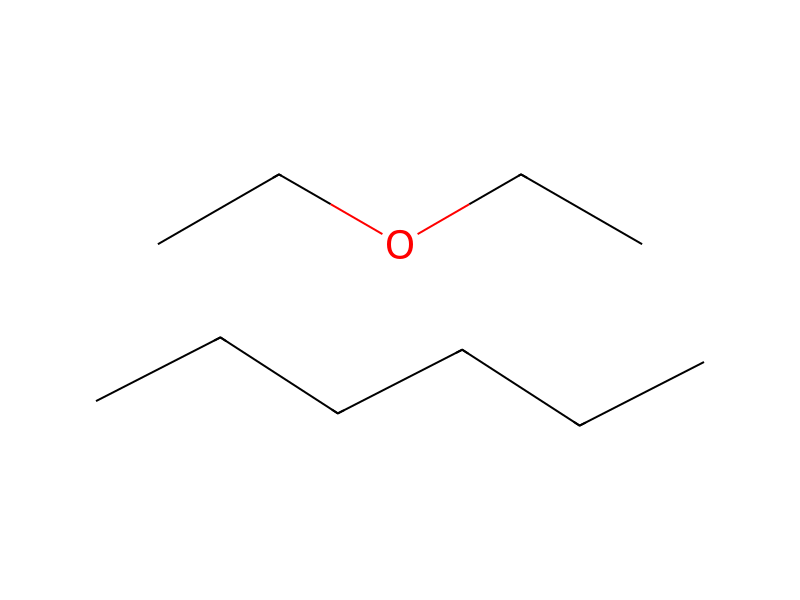
[OH:1][CH2:2][C:3]1[C:8]([F:9])=[C:7](NN)[N:6]=[C:5]([F:12])[C:4]=1[F:13].O.CCCCCC.C(OCC)C.[ClH:26]>[Cu](Cl)Cl>[Cl:26][C:7]1[C:8]([F:9])=[C:3]([CH2:2][OH:1])[C:4]([F:13])=[C:5]([F:12])[N:6]=1Participants





Procedure
To a solution of 0.35 g (0.0026 mole) of copper (II) chloride in 25 ml of concentrated hydrochloric acid was added slowly at room temperature 0.5 g (0.0026 mole) of (4-hydroxymethyl-2,3,5-trifluoropyridin-6-yl)hydrazine (from Example 6). This mixture was stirred at ambient temperature for two hours and was then refluxed for one hour. After being cooled, the reaction mixture was poured into water and was extracted with diethyl ether. The extract was dried over anhydrous magnesium sulfate, filtered, and the solvent evaporated under reduced pressure, leaving a brown, oily residue. This residue was passed through a short column of silica gel using a hexane/diethyl ether (50/50) mixture as eluant. The appropriate fractions were combined, and the solvent evaporated under reduced pressure, yielding 0.31 g of 2-chloro-4-hydroxymethyl-3,5,6-trifluoropyridine as a yellowish-brown liquid.
Workup
- temperaturewas then refluxed for one hour
- temperatureAfter being cooled
- extractionwas extracted with diethyl ether
- dry with materialThe extract was dried over anhydrous magnesium sulfate
- filtrationfiltered
- customthe solvent evaporated under reduced pressure
- customleaving a brown, oily residue
- customthe solvent evaporated under reduced pressure
Sources & evidence
- ORD record
- ord-76d95ccec31646a5a4ac6509679b3823
- Source dataset
- uspto-grants-1987_10
- Patent number
- US04701464
Reaction notes
Loading…