Urea → (2S)-6-Amino-2-hydroxyhexanoic acid
Reaction equation

N[C@H:2]([C:8]([OH:10])=[O:9])[CH2:3][CH2:4][CH2:5][CH2:6][NH2:7].N([O-])=[O:12].[Na+].N(O)=O.NC(N)=O>OS(O)(=O)=O.O>[NH2:7][CH2:6][CH2:5][CH2:4][CH2:3][C@H:2]([OH:12])[C:8]([OH:10])=[O:9]Participants
Reactant 4

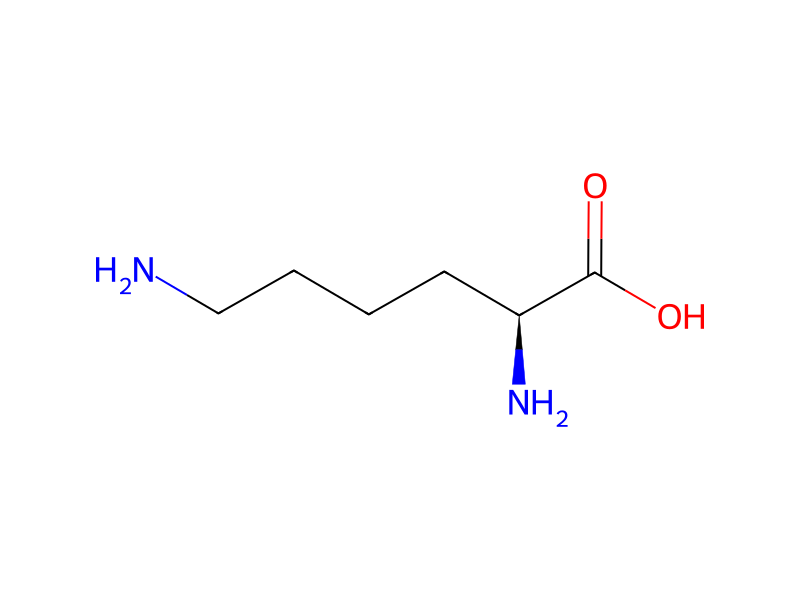


Product 1

Reagents, catalysts & solvents 2


Procedure
The crude L-lysine.2H2SO4 was taken up in 10% H2SO4 (250 ml) and treated dropwise with a solution of sodium nitrite (25.9 gm, 0.36 mole) in water (100 ml) at 45°-50° C. (bath temperature) over a period of 2 hours. When the addition was complete, the mixture was stirred at 45°-50° C. for an additional 4.5 hours, the excess nitrous acid decomposed with urea and the mixture poured onto an AG-50-X8 ion exchange column (H+ form, 200 ml bed volume). The column was eluted with water and then aqueous NH4OH (conc. NH4OH--H2O; 1:3) to elute the product. The ninhydrin positive fractions were combined and evaporated to give a pink semi-solid which was recrystallized from H2O--EtOH to give title compound (8.20 gm, 56%) as white crystals, m.p. 197°-199° C. [α]D =-12.2° (c=1.2, H2O)[Lit m.p. 203°-206° C., [α]D =-12.1° (c=1.16, H2O)]. TLC (i-iPrOH-conc. NH4OH--H2O; 7:2:1) Rf =0.16 (contains trace of lysine, Rf =0.02).
Workup
- additionWhen the addition
- additionthe mixture poured onto an AG-50-X8 ion exchange column (H+ form, 200 ml bed volume)
- washThe column was eluted with water
- washaqueous NH4OH (conc. NH4OH--H2O; 1:3) to elute the product
- customevaporated
- customto give a pink semi-solid which
- customwas recrystallized from H2O--EtOH
Sources & evidence
- ORD record
- ord-444d95ff2f394a8896120edc406618ce
- Source dataset
- uspto-grants-1987_10
- Patent number
- US04703043
Reaction notes
Loading…