Aniline → M-Phenylenediamine
Reaction equation

FF.[F:3][C:4]1[CH:9]=[CH:8][CH:7]=[CH:6][CH:5]=1.Cl.[NH2:11][C:12]1[CH:17]=[CH:16][CH:15]=[CH:14][CH:13]=1.[Cl-].C1([N+:25]#N)C=CC=CC=1.[F:27][B-](F)(F)F.NC1C=CC=CC=1.[F-].C1([N+]#N)C=CC=CC=1>F>[F:3][C:4]1[CH:9]=[CH:8][CH:7]=[C:6]([F:27])[CH:5]=1.[C:14]1([NH2:25])[CH:15]=[CH:16][CH:17]=[C:12]([NH2:11])[CH:13]=1Participants
Reactant 7




Product 2

Reagents, catalysts & solvents 1
Procedure
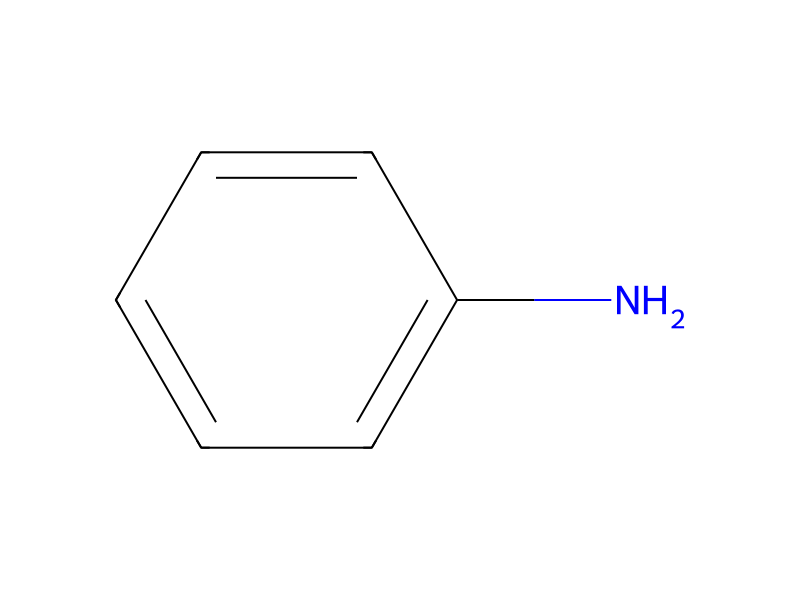
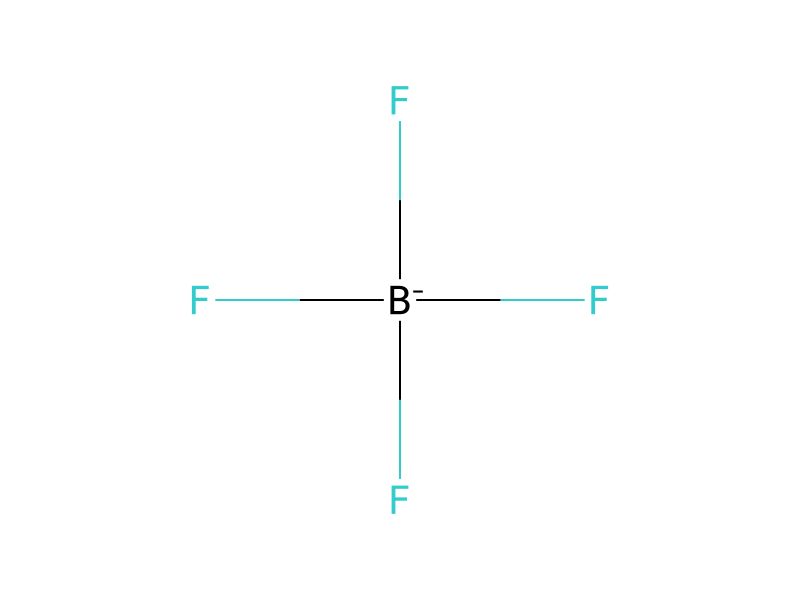
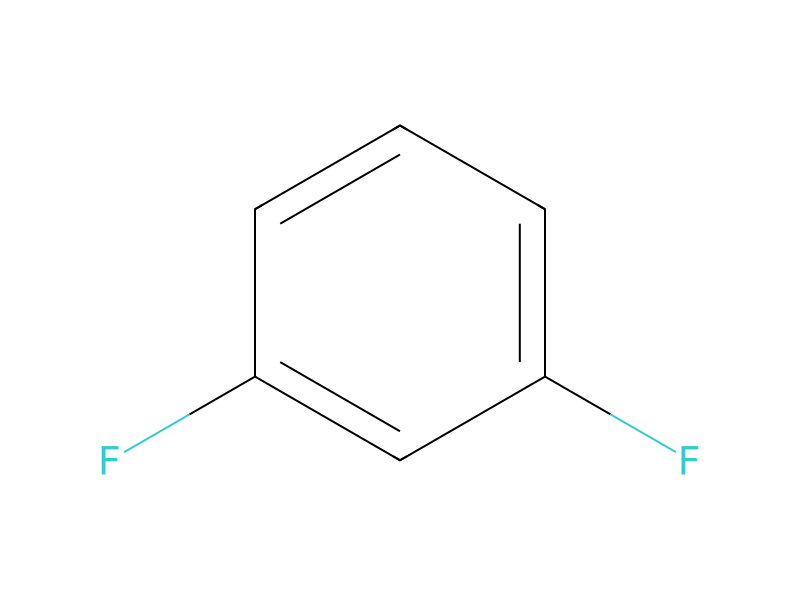
Fluorobenzenes have hitherto been prepared from the corresponding substituted anilines by diazotization and subsequent replacement of the diazo group by fluorine. Thus the preparation of fluorobenzene by diazotization of aniline hydrochloride, conversion of the resulting benzenediazonium chloride into the tetrafluoroborate and subsequent heating has long been known (G. Balz and G. Schiemann, Ber. 60 (1927) 1188; D. T. Flood, Org. Synth. Coll. Vol II (1943) 295). In addition, the preparation of fluorobenzene by diazotization of aniline in anhydrous hydrogen fluoride at 0° C. with subsequent decomposition of the resulting benzenediazonium fluoride at 20° C. is also described (Kirk-Othmer, Encyclopedia of Chemical Technology, 3rd ed. Vol. 10, p. 908). 1,3-Difluorobenzene could be obtained analogously in a 31% yield, relative to m-phenylenediamine as starting compound, by heating benzene-1,3-bis-diazonium tetrafluoroborate (G. Schiemann and R. Pillarsky, Ber. 62 (1929) 3035-3043, especially 3029). The diazotization of 3-fluoroaniline in anhydrous hydrogen fluoride in the presence of either ammonium fluoride or tertiary amines or dimethyl sulfoxide produced in each case 1,3-difluorobenzene in a yield of 46 to 73% (U.S. Pat. No. 4,075,252 and U.S. Pat. No. 4,096,196).
Workup
- temperaturesubsequent heating
Sources & evidence
- ORD record
- ord-1930399397974ff2b32f0c38d68ddfc8
- Source dataset
- uspto-grants-1993_11
- Patent number
- US05264094
Reaction notes
Loading…