Sulfanilamide → Bisphenol A diglycidyl ether
Reaction equation

[CH2:1]([O:5][CH2:6][CH:7]1O[CH2:8]1)[CH:2]1[O:4][CH2:3]1.O[C:11]1[CH:26]=[CH:25][C:14]([C:15](NC2C=CC(O)=CC=2)=O)=[CH:13]C=1.S(N)(=O)([C:29]1[CH:34]=[CH:33][C:32](N)=[CH:31][CH:30]=1)=O>>[CH3:15][C:14]([C:25]1[CH:8]=[CH:7][C:6]([O:5][CH2:1][CH:2]2[O:4][CH2:3]2)=[CH:11][CH:26]=1)([C:29]1[CH:34]=[CH:33][C:32]([O:5][CH2:1][CH:2]2[O:4][CH2:3]2)=[CH:31][CH:30]=1)[CH3:13]Participants
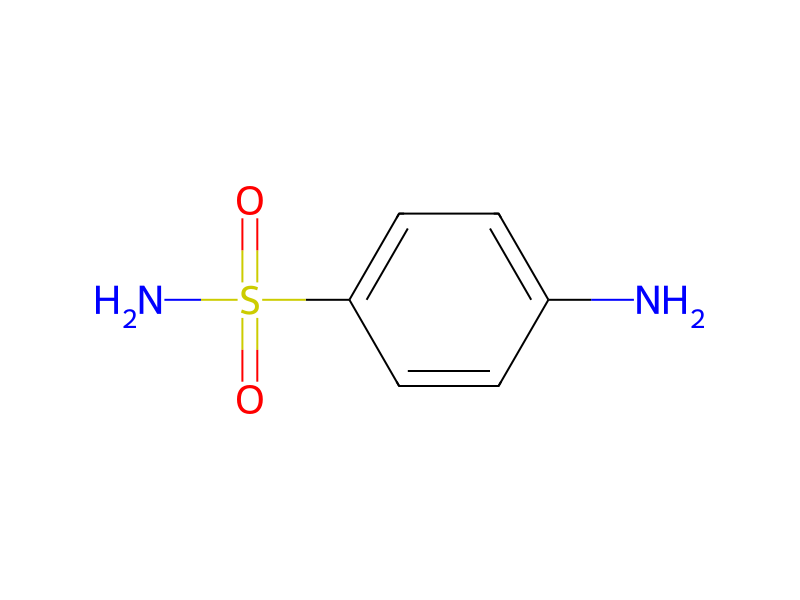


Conditions
- Temperature
- 130 °C
Procedure
Part of the diglycidyl ether of 4,4'-dihydroxybenzanilide prepared from B (4.3925 grams) is combined and mixed with an equivalent amount of a curing agent, sulfanilamide (1.0624 grams). This blend of solids is then placed in a 175° C. convection oven. After melt has occurred (approximately 10 minutes) the resinous mixture is poured into a mold (dimensions=7.5"×0.5"×0.021"; 190.5 mm×12.7 mm×0.53 mm) also located in the same convection oven. This mold i3 then placed in a mechanical press heated to 130° C. Pressure (approximately 2,000 psi, 13.8 MPa) is then applied to the mold within 5 minutes. After 1.5 hours at 130° C., the temperature of the press is increased and held for one hour at the following temperatures: 160° C., 180° C. and 200° C. After one hour at 200° C., the temperature of the press is raised to 225° C. where it is held for two hours before it is allowed to cool to room temperature. After cooling to room temperature an opaque casting is obtained from the mold. The flash from this casting, which results from excess resin being squeezed from the mold, exhibits a birefringent texture which is oriented in the direction of its flow formation. The apparent glass transition temperature for this polymer is 245° C. as determined by thermal mechanical analysis which is 65° C. higher than that obtained for the diglycidyl ether of bisphenol A in Comparative Experiment A-2. The average tensile strength and modulus for two cast films prepared using this procedure are 12,450 psi (85.8 MPa) (standard deviation=1,460 psi, 10.1 MPa) and 635,000 psi (4,378.2 MPa) (standard deviation =3,500 psi, 24.1 MPa), respectively. These values represent a 41 and 23 percent improvement for these respective properties when compared to those obtained for the diglycidyl ether of bisphenol A in Comparative Experiment A-2. The results are reported in Table VI.
Workup
- customis then placed in a 175° C.
- custom(approximately 10 minutes)
- additionis poured into a mold (dimensions=7.5"×0.5"×0.021"; 190.5 mm×12.7 mm×0.53 mm)
- waitAfter 1.5 hours at 130° C.
- temperaturethe temperature of the press is increased
- waitheld for one hour at the following temperatures
- custom160° C., 180° C. and 200° C
- waitAfter one hour at 200° C.
- temperaturethe temperature of the press is raised to 225° C. where it
- waitis held for two hours before it
- temperatureto cool to room temperature
- temperatureAfter cooling to room temperature an opaque casting
- customis obtained from the mold
- customThe flash from this casting, which results from excess resin
- customis 245° C.
- customis 65° C.
Sources & evidence
- ORD record
- ord-a45318d3d19b4a869d231dc944cc743b
- Source dataset
- uspto-grants-1993_11
- Patent number
- US05266660
Reaction notes
Loading…