Water → (4-Chloro-2-fluorophenyl)hydrazine
Reaction equation

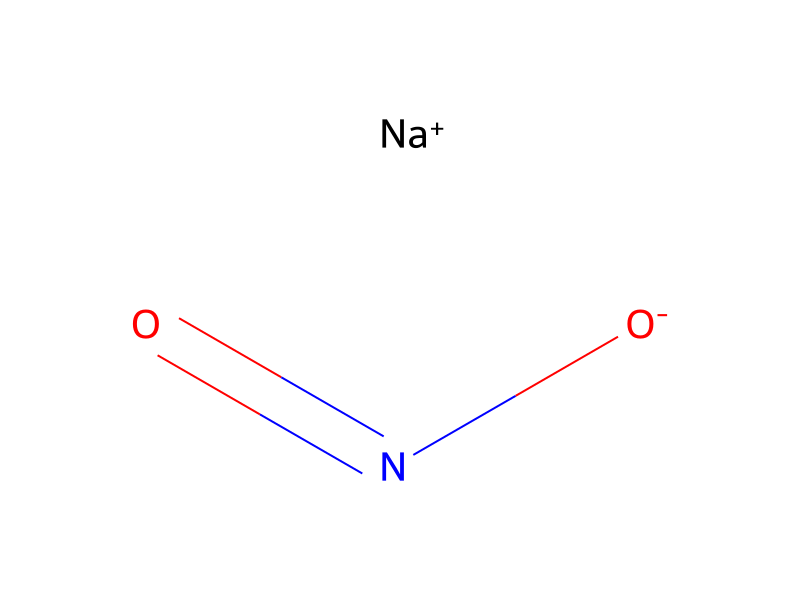
[Cl:1][C:2]1[CH:8]=[CH:7][C:5]([NH2:6])=[C:4]([F:9])[CH:3]=1.[N:10]([O-])=O.[Na+].O>Cl>[Cl:1][C:2]1[CH:8]=[CH:7][C:5]([NH:6][NH2:10])=[C:4]([F:9])[CH:3]=1Participants
Reactant 3

Product 1

Reagents, catalysts & solvents 1
Procedure
Alternatively, 4-chloro-2-fluorophenyl hydrazine is prepared by the following method. 43.7 parts of 4-chloro-2-fluoroaniline was dissolved in 735 parts of concentrated hydrochloric acid. The solution was cooled to 0°-5° C. and a solution of 22.8 parts of sodium nitrite in 187 parts water was added dropwise maintaining the temperature of the reaction between 0°-5°. The excess nitrite was destroyed by the addition of small amounts of sulfamic acid until a negative test with sulfone reagent was obtained. To the solution of the diazonium salt was added, as rapidly as possible, a solution of 170 parts stannous chloride dihydrate in 275 parts of concentrated hydrochloric acid, precooled to -50°. When the addition was complete, a heavy white precipitate formed. The reaction mixture was allowed to warm to ambient temperature over one hour. The precipitate was collected by filtration, then suspended in 750 parts ice-water. The pH of the solution was adjusted to 11 by the addition of 50% aqueous sodium hydroxide. The resulting aqueous suspension was extracted three times; 200 parts of methylene chloride was used for each extraction. The combined organic extracts were dried with anhydrous magnesium sulfate, and the solvent removed under reduced pressure of 300 mm Hg to leave 38.5 parts of pinkish-tan crystalline 4-chloro-2-fluoro-phenylhydrazine, mp 51°-63°.
Workup
- customAlternatively, 4-chloro-2-fluorophenyl hydrazine is prepared by the following method
- temperatureThe solution was cooled to 0°-5° C.
- temperaturemaintaining
- customthe temperature of the reaction between 0°-5°
- customThe excess nitrite was destroyed by the addition of small amounts of sulfamic acid until a negative test with sulfone reagent
- customwas obtained
- customprecooled to -50°
- additionWhen the addition
- customa heavy white precipitate formed
- filtrationThe precipitate was collected by filtration
- additionThe pH of the solution was adjusted to 11 by the addition of 50% aqueous sodium hydroxide
- extractionThe resulting aqueous suspension was extracted three times
- extraction200 parts of methylene chloride was used for each extraction
- dry with materialThe combined organic extracts were dried with anhydrous magnesium sulfate
- customthe solvent removed under reduced pressure of 300 mm Hg
Sources & evidence
- ORD record
- ord-0c177222e0cc46d7bde51825e6fe527a
- Source dataset
- uspto-grants-1977_07
- Patent number
- US04033751
Reaction notes
Loading…