Hydrochloric Acid → 2-Amino-5-chloropyridin-3-ol
Reaction equation
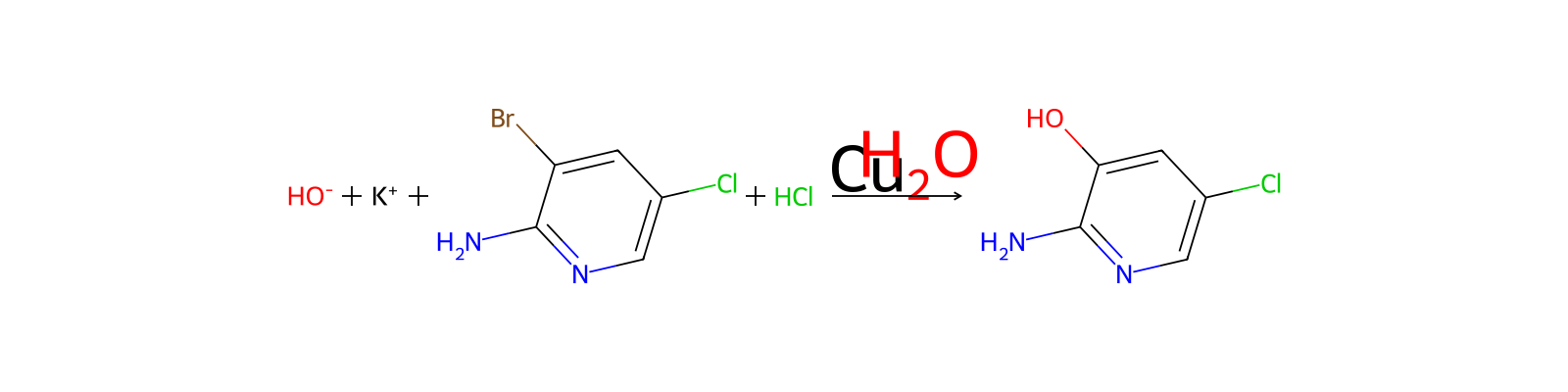
[OH-:1].[K+].[NH2:3][C:4]1[C:9](Br)=[CH:8][C:7]([Cl:11])=[CH:6][N:5]=1.Cl>[Cu].O>[NH2:3][C:4]1[C:9]([OH:1])=[CH:8][C:7]([Cl:11])=[CH:6][N:5]=1Participants
6
Reactant 3



Product 1

Reagents, catalysts & solvents 2


Conditions
- Temperature
- 170 °C
Procedure
A mixture of 12 parts of potassium hydroxide (85%), 200 parts of water, 10.4 parts of 2-amino-3-bromo-5-chloropyridine and 0.5 part of copper powder is stirred under nitrogen in an autoclave for 10 hours at 170° C. The aqueous solution is afterwards neutralised with concentrated hydrochloric acid and the water is largely evaporated off. While still moist the residue is extracted in the hot state twice with ethyl acetate. The combined extracts are purified with active charcoal, and the solvent is then evaporated off to leave 5 parts (70% of theory) of 2-amino-3-hydroxy-5-chloropyridine, m.p. 196°-201° C.
Workup
- customthe water is largely evaporated off
- extractionWhile still moist the residue is extracted in the hot state twice with ethyl acetate
- customThe combined extracts are purified with active charcoal
- customthe solvent is then evaporated off
Sources & evidence
- ORD record
- ord-842e2554ff6647cd8bdc6689c98c502f
- Source dataset
- uspto-grants-1977_07
- Patent number
- US04033975
Reaction notes
Loading…