Triethylamine → 2-Bromo-1-(3-phenyl-2,3-dihydro-1H-indol-1-yl)propan-1-one
Reaction equation

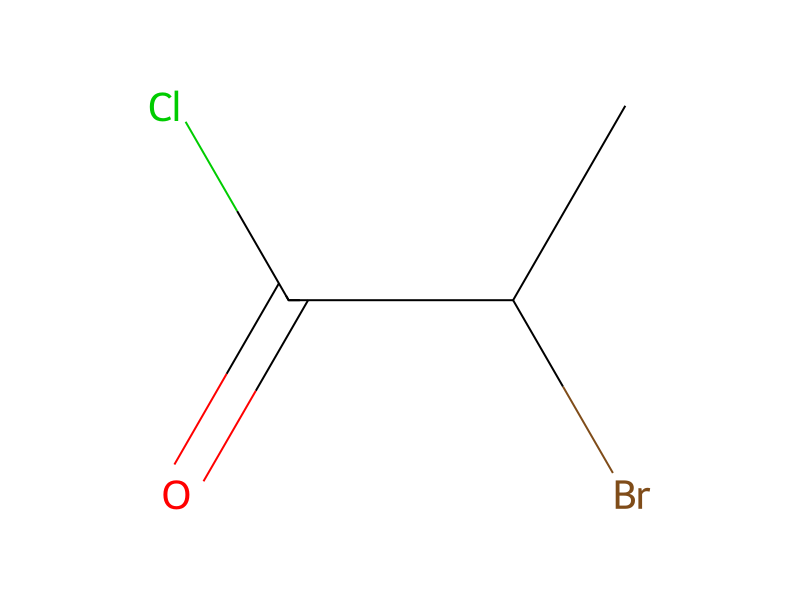
[Br:1][CH:2]([CH3:6])[C:3](Cl)=[O:4].[C:7]1([CH:13]2[C:21]3[C:16](=[CH:17][CH:18]=[CH:19][CH:20]=3)[NH:15][CH2:14]2)[CH:12]=[CH:11][CH:10]=[CH:9][CH:8]=1.C(N(CC)CC)C>C1C=CC=CC=1>[Br:1][CH:2]([CH3:6])[C:3]([N:15]1[C:16]2[C:21](=[CH:20][CH:19]=[CH:18][CH:17]=2)[CH:13]([C:7]2[CH:8]=[CH:9][CH:10]=[CH:11][CH:12]=2)[CH2:14]1)=[O:4]Participants
5



Procedure
A solution of 3.0 g of 2-bromopropionylchloride in 5 ml of benzene was added dropwise at 10° C. to a mixture of 3.0 g of 3-phenylindoline, 3.0 ml of triethylamine in 30 ml of dry benzene. The mixture was then washed with water, the benzene layer dried over sodium sulfate and the solvent removed in vacuo at room temperature to leave 4.9 g of the desired N-(2-bromopropionyl)-3-phenylindoline as a resin.
Workup
- washThe mixture was then washed with water
- dry with materialthe benzene layer dried over sodium sulfate
- customthe solvent removed in vacuo at room temperature
Sources & evidence
- ORD record
- ord-4a59b7c62f2043449ee9658555c1c9b5
- Source dataset
- uspto-grants-1979_05
- Patent number
- US04153789
Reaction notes
Loading…