Hydrochloric Acid → 4-(1-Methyl-2,6-dioxo-1,2,6,7-tetrahydro-3H-purin-3-yl)butanoic acid
Reaction equation
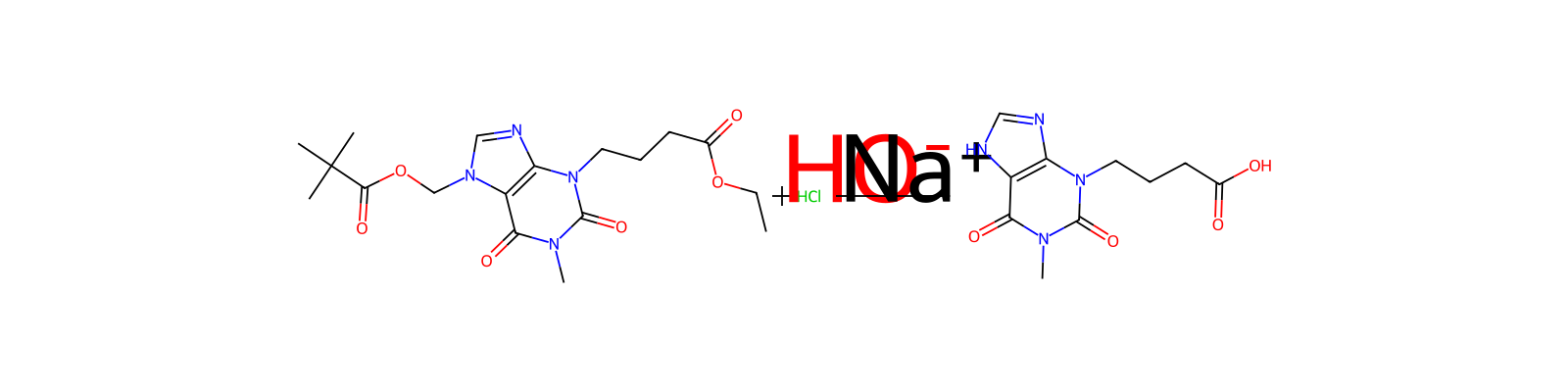
[CH3:1][N:2]1[C:11](=[O:12])[C:10]2[N:9](COC(=O)C(C)(C)C)[CH:8]=[N:7][C:6]=2[N:5]([CH2:21][CH2:22][CH2:23][C:24]([O:26]CC)=[O:25])[C:3]1=[O:4].Cl>[OH-].[Na+]>[CH3:1][N:2]1[C:11](=[O:12])[C:10]2[NH:9][CH:8]=[N:7][C:6]=2[N:5]([CH2:21][CH2:22][CH2:23][C:24]([OH:26])=[O:25])[C:3]1=[O:4]Participants




Procedure
An oily suspension of 1-methyl-3(carboethoxypropyl)-7-(pivaloyloxymethyl)xanthine (508 mg) in 2 N NaOH(36.2 ml) was heated under nitrogen at 95°-100° for 2 hrs. The oil dissolved and the reaction was shown to be complete by TLC. After cooling the reaction mixure, it was acidified to pH 2-3 with 15 ml 12% hydrochloric acid and the solution extracted with 3×5 ml chloroform to remove the pivalic acid. After washing the chloroform extracts with 5 ml 0.5 N HCl, the aqueous solutions were combined and stripped to dryness and the residue dried in vacuo at room temperature. The crude product was dissolved in about 22 ml hot water, decolorized and concentrated to 15 ml, at which time 159 mg of a crystalline product was obtained upon cooling. m.p. 220°-221°.
Workup
- temperaturewas heated under nitrogen at 95°-100° for 2 hrs
- dissolutionThe oil dissolved
- temperatureAfter cooling the reaction mixure, it
- extractionthe solution extracted with 3×5 ml chloroform
- customto remove the pivalic acid
- washAfter washing the chloroform
- customthe residue dried in vacuo at room temperature
- dissolutionThe crude product was dissolved in about 22 ml hot water
- concentrationdecolorized and concentrated to 15 ml, at which time 159 mg of a crystalline product
- customwas obtained
- temperatureupon cooling
Sources & evidence
- ORD record
- ord-79d5d2133417466bbe624aedb088fa74
- Source dataset
- uspto-grants-1979_05
- Patent number
- US04156081
Reaction notes
Loading…