Formaldehyde → 4-Chloro-2,6-bis(hydroxymethyl)phenol
Reaction equation

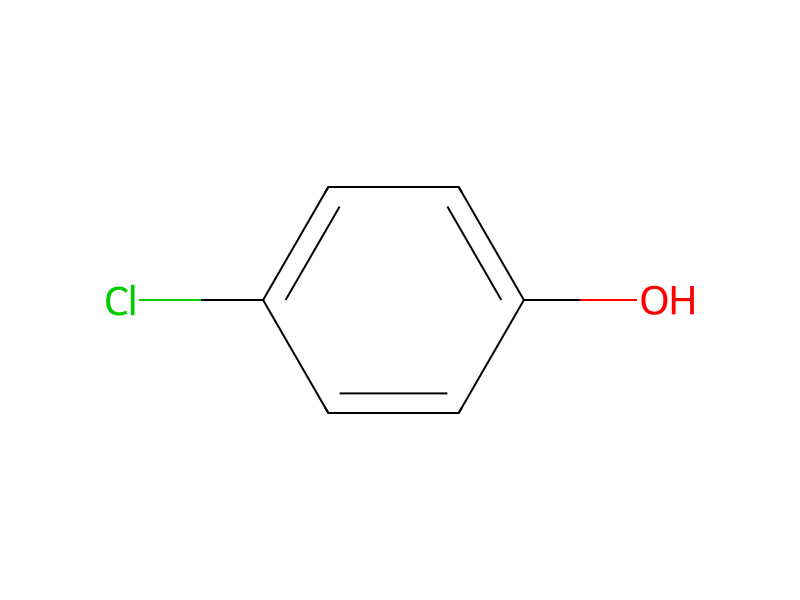
[OH:1][C:2]1C=C(O)C=CC=1CC1C=C(Cl)C=C(CC2C=CC(O)=CC=2O)C=1O.[CH2:27]=[O:28].[Cl:29][C:30]1[CH:35]=[CH:34][C:33]([OH:36])=[CH:32][CH:31]=1.[OH-].[Na+]>O>[OH:1][CH2:2][C:34]1[CH:35]=[C:30]([Cl:29])[CH:31]=[C:32]([CH2:27][OH:28])[C:33]=1[OH:36]Participants





Procedure
The heat reactable 2,6-bis(2,4-dihydroxy phenyl methyl)-4-chlorophenol composition used in the dip of the present invention is made by the process of first reacting about 2 mols of formaldehyde with 1 mol of parachlorophenol in water containing sodium hydroxide. The precipitated sodium salt is filtered off, washed, dissolved in hot water acidified with acetic acid, cooled, filtered and washed until free of acid. The resulting intermediate product can then be recrystallized from alcohol to obtain the 2,6-bis hydroxy methyl -4-chlorophenol which then is reacted with about 2 mols of resorcinol to give the heat reactable bis (dihydroxy phenyl methyl)chlorophenol composition. The final product may be treated to remove unused starting materials and by-products. However, it or the intermediate product should be washed or treated as much as practical to remove all or essentially all of the alkali metal ions or salts. The product as produced is substantially heat reactable 2,6-bis(2,4-dihydroxy phenyl methyl)-4-chlorophenol composition having an average molecular weight of up to about 800 and a melting point of up to about 240°C. It is added to or mixed with the latex of the rubbery vinyl pyridine copolymer in the form of a solution 5 to 30% solids in water containing NH3 sufficient to render the solution alkaline, usually about 0.5 to 7.5%. More information on how to prepare the heat reactable 2,6-bis(2,4-dihydroxy phenyl methyl)-4-chlorophenol composition is shown by Mather, "Development of a Polyester-Rubber Adhesive," British Polymer Journal, Volume 3, March, 1971, pages 58 to 62 and U.S. Pat. No. 3,660,202. The chlorophenolic composition is heat reactable so that it can react with itself, the rubber and possibly also the cord.
Workup
- filtrationThe precipitated sodium salt is filtered off
- washwashed
- dissolutiondissolved in hot water
- temperaturecooled
- filtrationfiltered
- washwashed until free of acid
- customThe resulting intermediate product can then be recrystallized from alcohol
Sources & evidence
- ORD record
- ord-28fc495b336c4c938542166b9c6f911f
- Source dataset
- uspto-grants-1976_03
- Patent number
- US03947394
Reaction notes
Loading…