Dimethyl terephthalate → Terephthalic Acid
Reaction equation

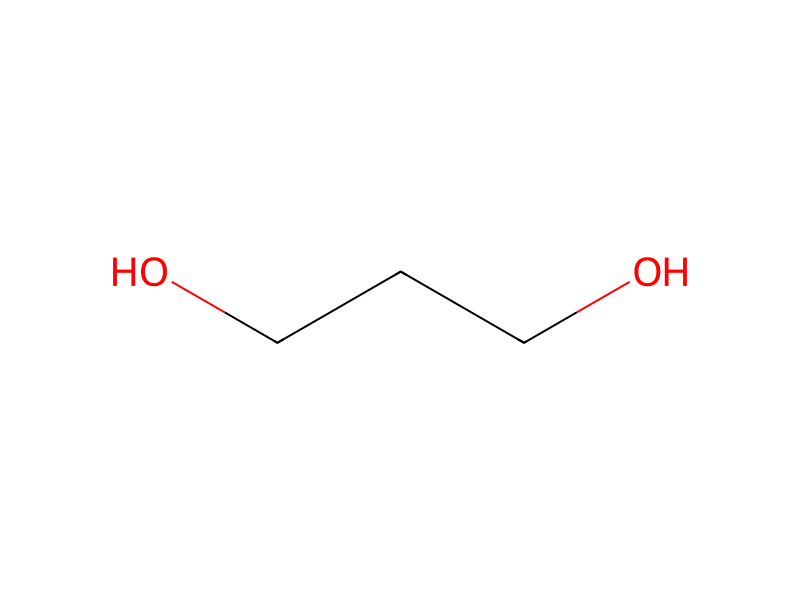
C[O:2][C:3](=[O:14])[C:4]1[CH:13]=[CH:12][C:7]([C:8]([O:10]C)=[O:9])=[CH:6][CH:5]=1.[CH2:15]([OH:19])[CH2:16][CH2:17][OH:18]>>[CH2:15]([OH:19])[CH2:16][CH2:17][OH:18].[C:8]([OH:10])(=[O:9])[C:7]1[CH:12]=[CH:13][C:4]([C:3]([OH:14])=[O:2])=[CH:5][CH:6]=1Participants


Conditions
- Temperature
- 237 °C
Procedure
Using an apparatus of the type indicated in the drawings, together with an ester exchanger, a 76.4 lb./hr (34.7 kg/hr) stream of dimethylterephthalate was preheated to a temperature of 185° C. and continuously mixed with a 44.9 lb./hr (20.4 kg/hr) stream of catalyzed 1,3-propanediol which was also preheated to a temperature of 185° C., to form a mixture having a mole ratio of 1.5 moles of 1,3-propanediol per mole of dimethylterephthalate. The catalyst was tetraisopropyl titanate (Tyzor® TPT, available from E. I. du Pont de Nemours and Company, Wilmington, Del.), DuPont Performance Chemicals), which was added to the 1,3-propanediol in an amount sufficient to yield 50 ppm by weight of titanium based on the total weight of poly(trimethylene terephthalate) formed in the process. The dimethylterephthalate/catalyzed 1,3-propanediol mixture was fed into the base of an ester exchanger, where the temperature of the liquid reactants was maintained at 237° C., and the pressure at the base of the ester exchanger was maintained at 900 to 950 mm Hg (119,970 to 126,635 Pa). The pressure at the top of the ester exchange column was atmospheric. In the ester exchanger, the 1,3-propanediol reacted with the dimethylterephthalate to form bis-3-hydroxypropyl terephthalate monomer and low molecular weight oligomers of 1,3-propanediol and terephthalic acid, liberating methanol vapor, which was continuously removed from the top of the ester exchanger. The monomer/oligomer mixture was continuously removed from the base of the ester exchanger and fed to the base of a prepolymerizer. In the prepolymerizer, the monomers and oligomers reacted to form a poly(trimethylene terephthalate) prepolymer, liberating 1,3-propanediol vapor. The 1,3-propanediol vapor and other gaseous by-products were removed from the top of the prepolymerizer and condensed. The poly(trimethylene terephthalate) prepolymer was continuously withdrawn from the uppermost plate of the prepolymerizer and fed to the inlet end of a finisher vessel. The temperature of the liquid reactants in the finisher was maintained at 255° C. In the finisher, the poly(trimethylene terephthalate) prepolymer reacted to form a higher molecular weight polymer, liberating additional 1,3-propanediol vapor. The 1,3-propanediol vapor and other gaseous by-products were continuously removed from the finisher. The poly(trimethylene terephthalate) was continuously removed from the finisher and pelletized. The conditions and results for the continuous polymerization are set forth in Table I for the prepolymerizer and Table II for the finisher.
Workup
- customformed in the process
Sources & evidence
- ORD record
- ord-f5f1d2859fe546848c32e64a68e66312
- Source dataset
- uspto-grants-2002_03
- Patent number
- US06353062B1
Reaction notes
Loading…