Benzenepropanoyl chloride → HCID 13461746, compound
Reaction equation

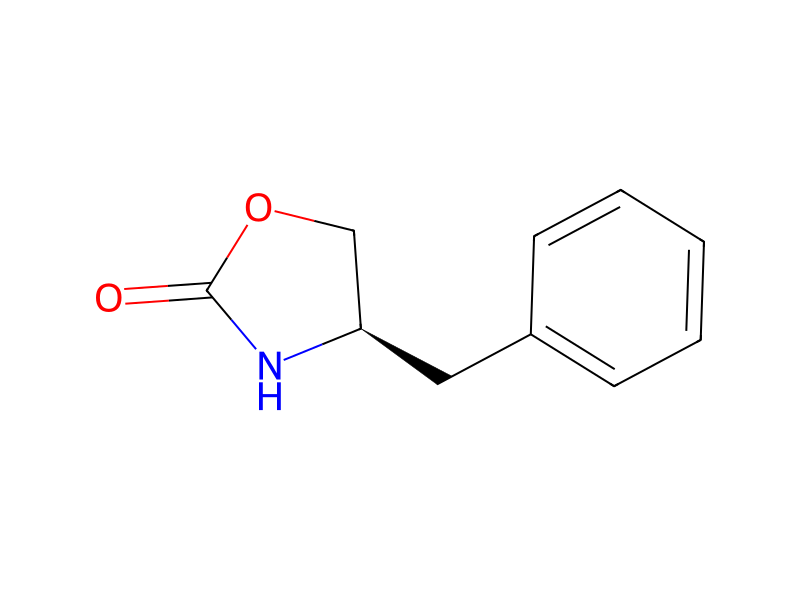
[CH2:1]([C@@H:8]1[CH2:12][O:11][C:10](=[O:13])[NH:9]1)[C:2]1[CH:7]=[CH:6][CH:5]=[CH:4][CH:3]=1.[Li]CCCC.[C:19](Cl)(=[O:28])[CH2:20][CH2:21][C:22]1[CH:27]=[CH:26][CH:25]=[CH:24][CH:23]=1>O1CCCC1>[CH2:1]([C@@H:8]1[CH2:12][O:11][C:10](=[O:13])[N:9]1[C:19](=[O:28])[CH2:20][CH2:21][C:22]1[CH:27]=[CH:26][CH:25]=[CH:24][CH:23]=1)[C:2]1[CH:3]=[CH:4][CH:5]=[CH:6][CH:7]=1Participants
Reactant 3


Product 1

Reagents, catalysts & solvents 1

Conditions
- Temperature
- -75 °C
Procedure
To a solution of (R)-(+)-4-benzyl-2-oxazolidinone (910 g, 5.14 mol) and 500 mg of 2,2′-dipyridyl as an indicator in tetrahydrofuran (9 L) at −78° C. was added over 30 minutes a 2.5 M solution of BuLi in hexanes (2.03 L, 5.14 mol). The temperature of the reaction mixture was maintained at less than −55° C. during the addition. The reaction mixture was cooled to −75° C. and hydrocinnamoyl chloride (950 g, 5.63 mol) was added over 5 minutes. The reaction mixture was allowed to warm to 0° C., at which point the reaction mixture was judged to be complete by thin layer chromatography (hexanes/ethyl acetate, 2:1). The reaction was quenched by adding 10% aqueous sodium bicarbonate (3.6 L) and water (3.6 L). The aqueous phase was separated and extracted with ethyl acetate (3 L). The combined organic layers were washed with 5% aqueous sodium carbonate (3.6 L) and saturated aqueous sodium chloride (2 L), dried over magnesium sulfate, and concentrated in vacuo to approximately 2 L of a viscous yellow suspension. This slurry was dissolved in ethyl acetate (3 L), concentrated to a solid, and dissolved in ethyl acetate at 50° C. Hexanes (10.7 L) was added, and the mixture was slowly cooled to 10° C. resulting in the precipitation of solids which were stirred at 10° C. for 30 minutes. The solids were collected by filtration, washed with hexanes, and air-dried at ambient temperature yielding 1.4 kg (88%) of (R)-4-benzyl-3-(3-phenyl-propionyl)-oxazolidin-2-one as pale yellow needles: 1H NMR (300 MHz, CDCl3) δ7.14-7.33 (m, 10H), 4.66 (m, 1H), 4.17 (t, J=3.4 Hz, 2H), 3.26 (m, 3H), 3.03 (t, J=7 Hz, 2H), 2.75 (dd, J=9.5, 13.4 Hz, 1H); IR 1787, 1761, 1699, 1390, 1375, 1308, 1208, 1203, 746, 699 cm−1; mp 102-104° C.
Workup
- temperatureThe temperature of the reaction mixture was maintained at less than −55° C. during the addition
- temperatureto warm to 0° C., at which
- customThe reaction was quenched
- additionby adding 10% aqueous sodium bicarbonate (3.6 L) and water (3.6 L)
- customThe aqueous phase was separated
- extractionextracted with ethyl acetate (3 L)
- washThe combined organic layers were washed with 5% aqueous sodium carbonate (3.6 L) and saturated aqueous sodium chloride (2 L)
- dry with materialdried over magnesium sulfate
- concentrationconcentrated in vacuo to approximately 2 L of a viscous yellow suspension
- dissolutionThis slurry was dissolved in ethyl acetate (3 L)
- concentrationconcentrated to a solid
- dissolutiondissolved in ethyl acetate at 50° C
- additionHexanes (10.7 L) was added
- temperaturethe mixture was slowly cooled to 10° C.
- customresulting in the precipitation of solids which
- filtrationThe solids were collected by filtration
- washwashed with hexanes
- customair-dried at ambient temperature
Sources & evidence
- ORD record
- ord-6ceb85cb8b9e4d6586ed2aa2c2a65da9
- Source dataset
- uspto-grants-2002_03
- Patent number
- US06355825B1
Reaction notes
Loading…