Hydrochloric Acid → Menadiol
Reaktionsgleichung

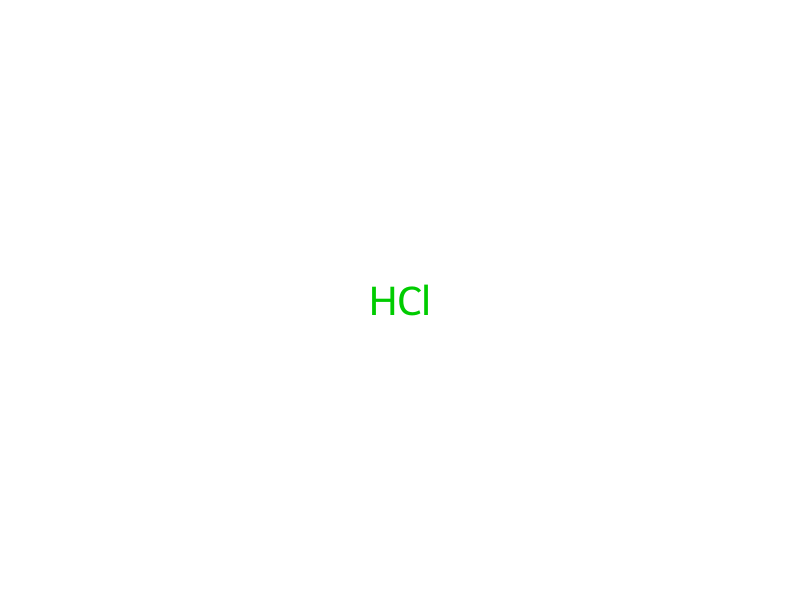
[CH3:1][C:2]1[C:12](=[O:13])[C:11]2[CH:10]=[CH:9][CH:8]=[CH:7][C:6]=2[C:4](=[O:5])[CH:3]=1.Cl>[Zn]>[OH:13][C:12]1[C:11]2[C:6](=[CH:7][CH:8]=[CH:9][CH:10]=2)[C:4]([OH:5])=[CH:3][C:2]=1[CH3:1]Komponenten
Edukt 2

Produkt 1

Reagenzien, Katalysatoren, Lösungsmittel 1

Versuchsvorschrift
First, vitamin K3 is reduced with a suitable reducing agent (e.g., zinc and hydrochloric acid) to form 1,4-dihydroxy-2-methylnaphthalene (III), which then is mono-acylated with an acylation reagent (e.g., benzoyl chloride) in the presence of a deacidification agent (e.g., pyridine), and, optionally, further benzylated with a benzylation reagent (e.g., benzyl bromide) and treated with an acid or a base (deacylation). Position 4 has thus undergone O-acylation or O-benzylation, providing 4-O-acyl-2-methylnaphthol or 4-O-benzyl-3-methylnaphthol (IV). Then, this is reacted with epichlorohydrin (chloromethyloxirane) in the presence of a deacidification agent to form 4-acyloxy-2-methyl-1-(2,3-epoxypropane)naphthol or 4-benzyloxy-3-methyl-1-(2,3-epoxypropane)naphthol (V), which in turn is reacted with a pyridylpiperazine, a pyrimidylpiperazine or a B1B2-substituted phenylpiperazine to form 1-(2-methyl-4-acyloxynaphthoxy)-3-[4-(2-pyridyl)-1-piperazinyl]-propan-2-ol, 1-(2-methyl-4-acyloxynaphthoxy)-3-[4-(2,6-pyrimidyl)-1-piperazinyl]propan-2-ol, or 1-(2-methyl-4-acyloxynaphthoxy)-3-[4-(B1B2-substituted phenyl)-1-piperazinyl]propan-2-ol or 1-(3-methyl-4-benzyloxynaphthoxy)-3-[4-(substitute moiety respectively corresponding to those aforementioned)-1-piperazinyl]propan-2-ol (VI), the protecting acyl or benzyl group at position 4 of which then is cleaved with a base or by catalytic reduction to give the present compound (I).
Quellen und Nachweise
- ORD-Eintrag
- ord-4de4e3fecd7e4b6a9b9cbeaa16643a8f
- Quelldatensatz
- uspto-grants-2002_03
- Patentnummer
- US06358515B2
Notizen zur Reaktion
Wird geladen…