Piperazine → 3-(1-Piperazinyl)-1,2-benzisothiazole
Reaction equation

[NH:1]1[CH2:6][CH2:5][NH:4][CH2:3][CH2:2]1.Cl[C:8]1[C:12]2[CH:13]=[CH:14][CH:15]=[CH:16][C:11]=2[S:10][N:9]=1.[OH-].[Na+]>>[S:10]1[C:11]2[CH:16]=[CH:15][CH:14]=[CH:13][C:12]=2[C:8]([N:1]2[CH2:6][CH2:5][NH:4][CH2:3][CH2:2]2)=[N:9]1Participants



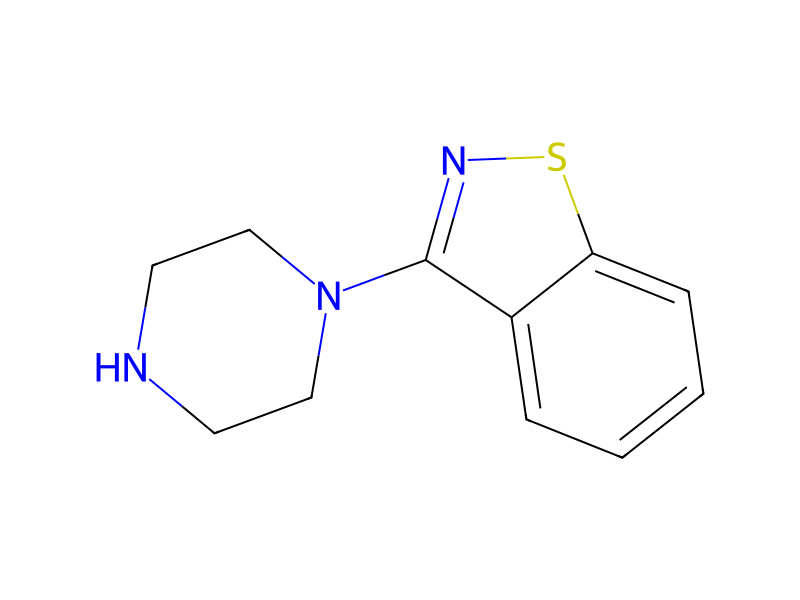
Procedure
A 4 L suction flask was charged with anhydrous piperazine (1582 g, 18.36 moles) followed by molten 3-chloro-1,2-benzisothiazole (Example 8, 622 g, 3.672 moles). The flask was stoppered with a wired-on rubber stopper and a short length of pressure tubing was wired-on to the side tube. The flask was evacuated (house vacuum) and the pressure tubing on the side arm clamped shut. The apparatus was then oven heated at 125° with occasional swirling as melting proceeded. After 24 hours at this temperature, the orange melt was quenched in 4.8 liter of cracked ice and water. One equivalent of 50% NaOH (293 g, 3.672 moles) was added in one portion. The mixture was extracted with methylene chloride and these extracts washed with water. Concentration in vacuo gave 734 g of crude product which was recrystallized from 1800 mL of boiling ethyl acetate to yield 548 g, 68%, m.p. 88°-90°.
Workup
- customThe flask was evacuated (house vacuum)
- temperatureoven heated at 125°
- customthe orange melt was quenched in 4.8 liter of cracked ice
- extractionThe mixture was extracted with methylene chloride
- washthese extracts washed with water
- concentrationConcentration in vacuo
Sources & evidence
- ORD record
- ord-1fdcc98bff5c4f8e9e887725ccce9058
- Source dataset
- uspto-grants-1986_05
- Patent number
- US04590196
Reaction notes
Loading…