Hydrochloric Acid → N-(piperidin-4-yl)pyridin-3-amine
Reaction equation
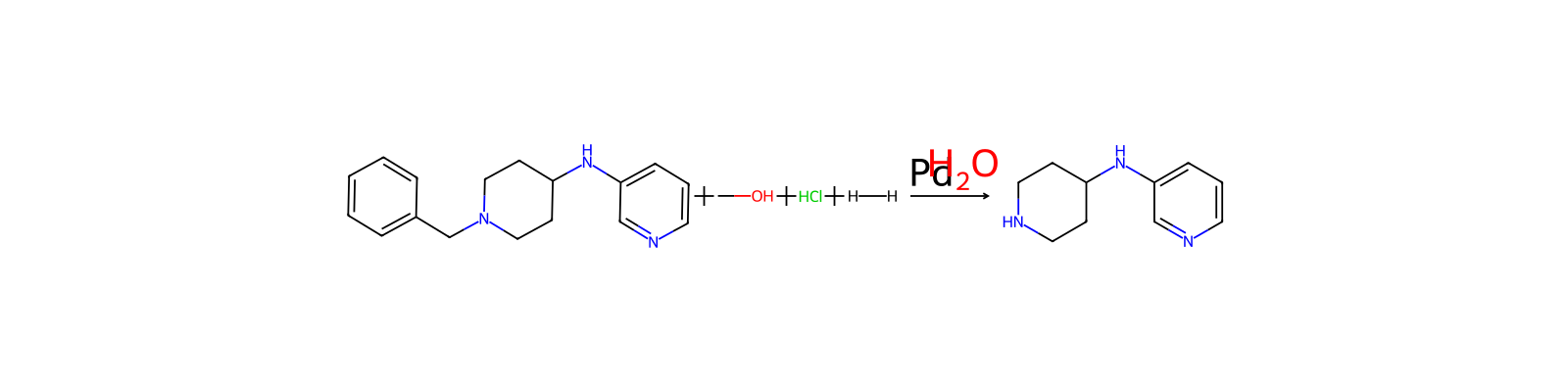
C1(C[N:8]2[CH2:13][CH2:12][CH:11]([NH:14][C:15]3[CH:16]=[N:17][CH:18]=[CH:19][CH:20]=3)[CH2:10][CH2:9]2)C=CC=CC=1.CO.Cl.[H][H]>[Pd].O>[NH:8]1[CH2:13][CH2:12][CH:11]([NH:14][C:15]2[CH:16]=[N:17][CH:18]=[CH:19][CH:20]=2)[CH2:10][CH2:9]1Participants







Procedure
A mixture of 20 parts of N-[1-(phenylmethyl)-4-piperidinyl]-3-pyridinamine, 160 parts of methanol, 30 parts of water and 12 parts of a concentrated hydrochloric acid solution is hydrogenated at normal pressure and at a temperature between 22°-39° C., in the presence of 7 parts of palladium-on-charcoal catalyst 10%. After the calculated amount of hydrogen is taken up, hydrogenation is stopped. The catalyst is filtered off and the filtrate is evaporated. The oily residue is dissolved in water. This solution is rendered alkaline with ammonium hydroxide, saturated with solid potassium carbonate and then extracted with methylbenzene. The extract is dried over potassium carbonate and evaporated. The solid residue is recrystallized from a mixture of 40 parts of benzene and 32 parts of 1,1'-oxybisethane, yielding 3 parts of N-(4-piperidinyl)-3-pyridinamine; mp. 127°-129° C.
Workup
- filtrationThe catalyst is filtered off
- customthe filtrate is evaporated
- dissolutionThe oily residue is dissolved in water
- extractionsaturated with solid potassium carbonate and then extracted with methylbenzene
- dry with materialThe extract is dried over potassium carbonate
- customevaporated
- customThe solid residue is recrystallized from a mixture of 40 parts of benzene and 32 parts of 1,1'-oxybisethane
Sources & evidence
- ORD record
- ord-a8c77a8363bd4bd2b48394630ffccb7b
- Source dataset
- uspto-grants-1980_09
- Patent number
- US04225606
Reaction notes
Loading…