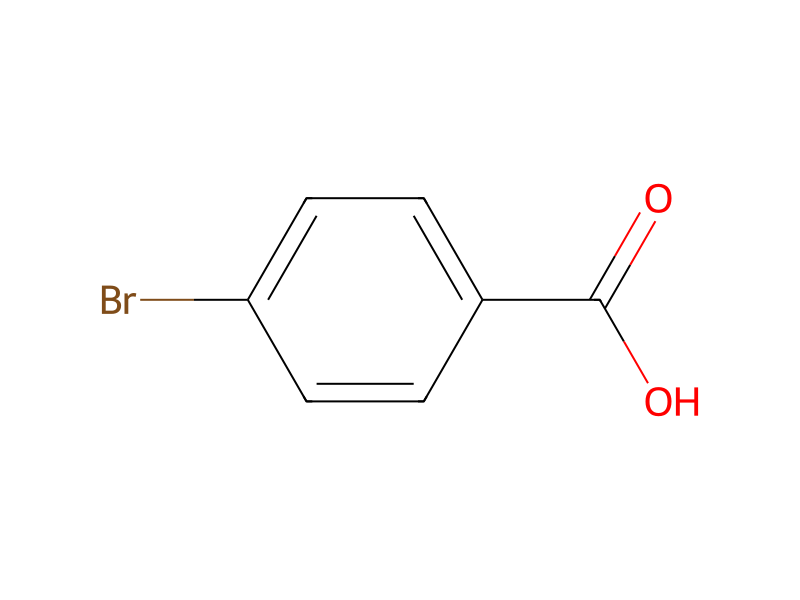
4-Bromobenzoic acid → 5-Bromo-2-(4-bromophenyl)-1,3-benzothiazole
Reaction equation

Cl.[Br:2][C:3]1[CH:8]=[CH:7][C:6]([SH:9])=[C:5]([NH2:10])[CH:4]=1.[Br:11][C:12]1[CH:20]=[CH:19][C:15]([C:16](O)=O)=[CH:14][CH:13]=1.O.CO>S1(CCCC1)(=O)=O>[Br:11][C:12]1[CH:20]=[CH:19][C:15]([C:16]2[S:9][C:6]3[CH:7]=[CH:8][C:3]([Br:2])=[CH:4][C:5]=3[N:10]=2)=[CH:14][CH:13]=1Participants
5


Conditions
- Temperature
- 70 °C
Procedure
A mixture of 20 g (0.083 mole) of 4-bromo-2-aminothiophenol hydrochloride and 270 g of deoxygenated polyphosphoric acid was heated at 70° C. for 4 hours. To this mixture was added a solution containing 22 g (0.11 mole) of p-bromobenzoic acid dissolved in 109 g of sulfolane. The reaction mixture was slowly heated to 200° C. and maintained at that temperature for 1 hour. After cooling, the reaction mixture was poured into a 1:1 water-methanol solution to precipitate the product. The light tan precipitate was filtered, washed with dilute ammonium hydroxide, washed with water, and then air dried. The 2-(4-bromophenyl)-5-bromobenzothiazole was recrystallized from toluene to give 24.5 g (80% of theoretical), m.p. 162°-163° C.
Workup
- additionTo this mixture was added a solution
- temperatureThe reaction mixture was slowly heated to 200° C.
- temperaturemaintained at that temperature for 1 hour
- temperatureAfter cooling
- customto precipitate the product
- filtrationThe light tan precipitate was filtered
- washwashed with dilute ammonium hydroxide
- washwashed with water
- customair dried
- customThe 2-(4-bromophenyl)-5-bromobenzothiazole was recrystallized from toluene
- customto give 24.5 g (80% of theoretical), m.p. 162°-163° C.
Sources & evidence
- ORD record
- ord-ad6f6ad8538a4cbba72bb8f1a73c58a2
- Source dataset
- uspto-grants-1984_04
- Patent number
- US04442293
Reaction notes
Loading…