1-(2-Hydroxyethyl)piperazine → 2-[3-[4-(2-Hydroxyethyl)-1-piperazinyl]propyl]-1H-isoindole-1,3(2H)-dione
Reaction equation

Br[CH2:2][CH2:3][CH2:4][N:5]1[C:9](=[O:10])[C:8]2=[CH:11][CH:12]=[CH:13][CH:14]=[C:7]2[C:6]1=[O:15].[OH:16][CH2:17][CH2:18][N:19]1[CH2:24][CH2:23][NH:22][CH2:21][CH2:20]1.C(=O)([O-])[O-].[K+].[K+]>CC(C)=O>[OH:16][CH2:17][CH2:18][N:19]1[CH2:24][CH2:23][N:22]([CH2:2][CH2:3][CH2:4][N:5]2[C:9](=[O:10])[C:8]3=[CH:11][CH:12]=[CH:13][CH:14]=[C:7]3[C:6]2=[O:15])[CH2:21][CH2:20]1Participants
5


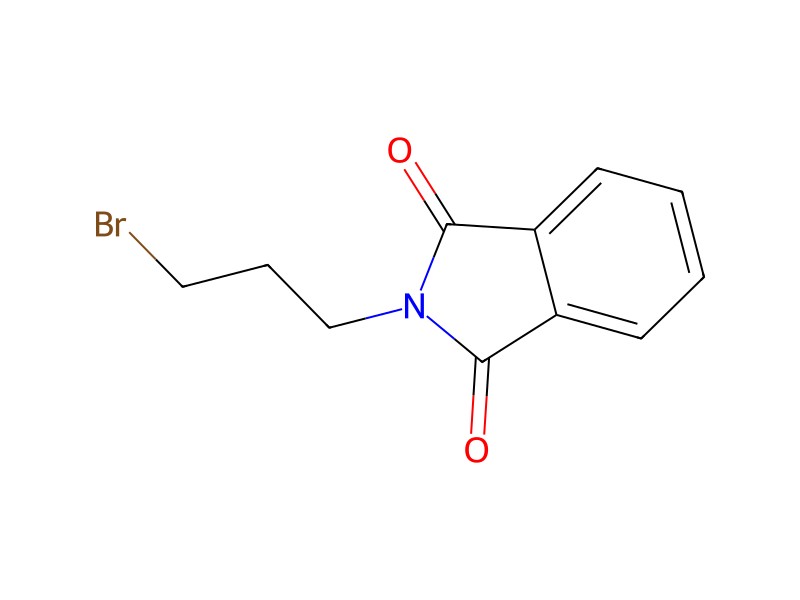


Procedure
To the solution of N-(3-bromopropyl)phthalimide (40.5 g) in acetone (375 ml) were added 1-(2-hydroxyethyl)piperazine (31.5 g) and potassium carbonate (63.0 g). The resulting mixture was refluxed with stirring for 3 hours. The reaction mixture was filtered and the filtrate was evaporated. The residual oil was subjected to column chromatography on silica gel, eluting with a mixture of chloroform and methanol (9:1). The fractions containing the object compound were collected and then evaporated to give an oil of N-[3-[4-(2-hydroxyethyl)-1-piperazinyl]propyl]phthalimide (25.5 g).
Workup
- temperatureThe resulting mixture was refluxed
- filtrationThe reaction mixture was filtered
- customthe filtrate was evaporated
- washeluting with a mixture of chloroform and methanol (9:1)
- additionThe fractions containing the object compound
- customwere collected
- customevaporated
Sources & evidence
- ORD record
- ord-de7e40b0fcbc47e6bc67205539581bbf
- Source dataset
- uspto-grants-1984_04
- Patent number
- US04443443
Reaction notes
Loading…