Acetonitrile → HCID 19922010, compound
Reaction equation

[Cl:1][C:2]1[CH:9]=[C:6]([CH:7]=[O:8])[C:5]([OH:10])=[CH:4][CH:3]=1.[Br:11][CH2:12][CH2:13][CH2:14][CH2:15][CH2:16]Br.C(=O)([O-])[O-].[K+].[K+].C(#N)C>CCOCC>[Br:11][CH2:12][CH2:13][CH2:14][CH2:15][CH2:16][O:10][C:5]1[CH:4]=[CH:3][C:2]([Cl:1])=[CH:9][C:6]=1[CH:7]=[O:8]Participants
6
Reactant 4



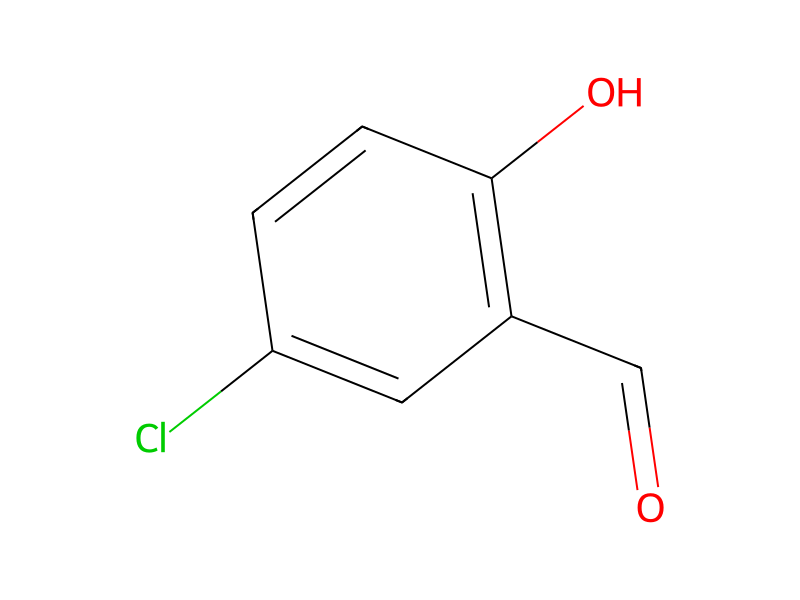
Product 1

Reagents, catalysts & solvents 1

Procedure
A mixture of 7.82 g (50 mmol) of 5-chlorosalicylaldehyde, 92.1 g (0.4 mmol) of 1,5-dibromopentane, 22.1 g (0.15 mol) of anhydrous granular potassium carbonate, and 360 mL of acetonitrile was stirred and refluxed for 20 hr. The resulting slurry was cooled and diluted with 300 mL of ether. The solids were removed by suction filtration and washed thoroughly with ether. The filtrate and washes with combined and concentrated under water aspirator pressure. The excess 1,5-dibromopentane was removed by distillation under high vacuum. Flash chromatography of the residue on silica gel (eluting with 4:1 hexane-ether) afforded 12.5 g (81.8%) of 2-[(5-bromopentyl)oxy]-5-chlorobenzaldehyde as a yellow oil.
Workup
- temperaturerefluxed for 20 hr
- temperatureThe resulting slurry was cooled
- customThe solids were removed by suction filtration
- washwashed thoroughly with ether
- concentrationThe filtrate and washes with combined and concentrated under water aspirator pressure
- customThe excess 1,5-dibromopentane was removed by distillation under high vacuum
Sources & evidence
- ORD record
- ord-29f3c75ff5d448da8dd41b7b3cec22ef
- Source dataset
- uspto-grants-1993_12
- Patent number
- US05273999
Reaction notes
Loading…