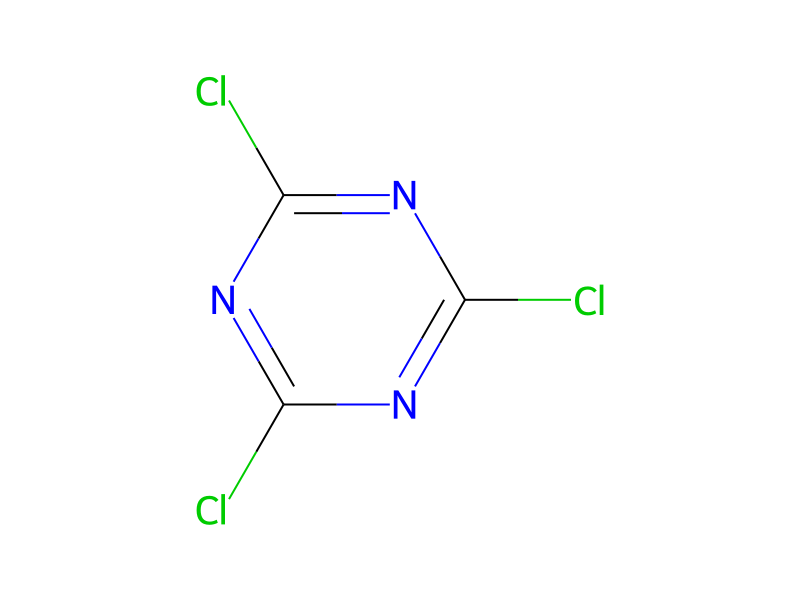
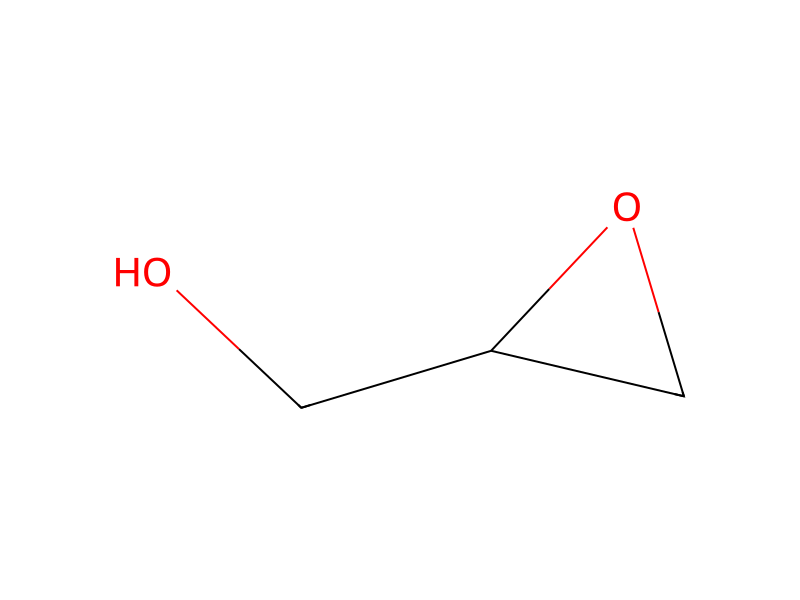
Cyanuric chloride → 2-Chloro-4,6-bis[(oxiran-2-yl)methoxy]-1,3,5-triazine
Reaction equation

[N:1]1[C:8](Cl)=[N:7][C:5](Cl)=[N:4][C:2]=1[Cl:3].[O:10]1[CH2:14][CH:11]1[CH2:12][OH:13].[OH-:15].[Na+]>C(Cl)(Cl)Cl>[Cl:3][C:2]1[N:4]=[C:5]([O:13][CH2:12][CH:11]2[O:10][CH2:14]2)[N:7]=[C:8]([O:15][CH2:12][CH:11]2[O:10][CH2:14]2)[N:1]=1Participants
Reactant 3

Product 1

Reagents, catalysts & solvents 1

Procedure
To a mechanically stirred solution of 220.8 g (1.2 mol) cyanuric chloride in 1500 ml chloroform, cooled to 0°-10° C., was added 266.4 g (3.6 mol) 2,3-epoxy-1-propanol in one portion. Aqueous sodium hydroxide (50% solution; 192 g) was added to the mixture dropwise with stirring over about 3 hr maintaining the reaction temperature below 10° C. and preferably around 0°-5° C. The reaction mixture was allowed to warm slowly to room temperature. The chloroform layer was washed with distilled water until neutral and dried over magnesium sulfate. The reaction product was found by nuclear magnetic resonance to be 2-chloro-4,6-diglycidoxy-1,3,5-triazine. Analysis showed about 95% (by weight) chlorodiglycidoxytriazine. The reaction mixture also was found to contain small amounts of triglycidoxytriazine and dichloro monoglycidoxytriazine.
Workup
- temperaturemaintaining the reaction temperature below 10° C. and preferably around 0°-5° C
- washThe chloroform layer was washed with distilled water until neutral and
- dry with materialdried over magnesium sulfate
Sources & evidence
- ORD record
- ord-082ba3701cbf478cab5efa205c7b6b08
- Source dataset
- uspto-grants-1990_01
- Patent number
- US04895945
Reaction notes
Loading…