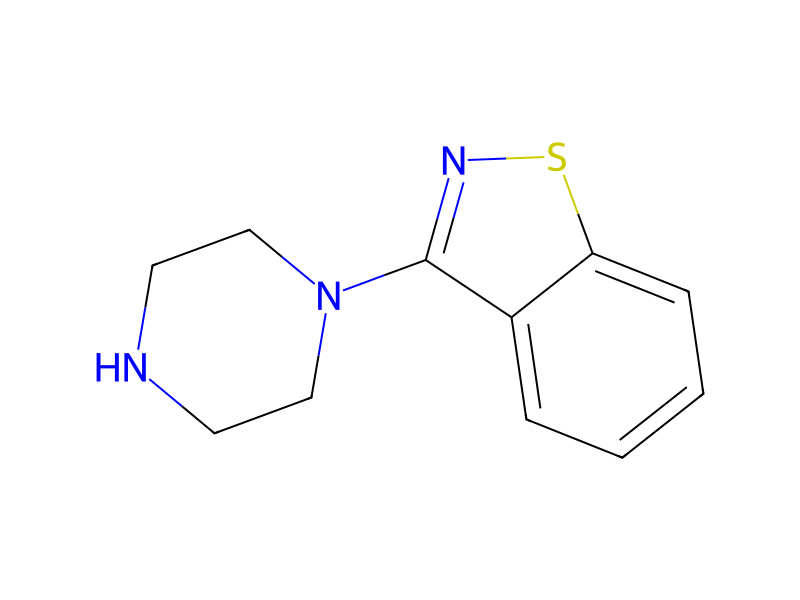
Water → 3-(1-Piperazinyl)-1,2-benzisothiazole
Reaction equation

[NH:1]1[CH2:6][CH2:5][NH:4][CH2:3][CH2:2]1.Cl[C:8]1[C:12]2[CH:13]=[CH:14][CH:15]=[CH:16][C:11]=2[S:10][N:9]=1.O>CC(O)(C)C>[N:1]1([C:8]2[C:12]3[CH:13]=[CH:14][CH:15]=[CH:16][C:11]=3[S:10][N:9]=2)[CH2:6][CH2:5][NH:4][CH2:3][CH2:2]1Participants
5
Reactant 3



Product 1
Reagents, catalysts & solvents 1

Conditions
- Temperature
- 2.5 °C
Procedure
A mixture of piperazine (10.2 g, 0.118 mmol) and 3-chloro-1,2-benzisothiazole (4.0 g, 0.024 mmol) in t-BuOH (4 mL) was refluxed overnight. The reaction mixture was poured into water (100 mL) and extracted with toluene (200 mL). The organic phase was dried over MgSO4 and evaporated until about 20 mL remained, under vacuum. The resulting suspension was cooled at 0-5° C. overnight. The precipitate was filtered and dried under vacuum to provide 3-(piperazin-1-yl)benzo[d]isothiazole as an intermediate (3.36 g, 15.4 mmol, 65%).
Workup
- temperaturewas refluxed overnight
- extractionextracted with toluene (200 mL)
- dry with materialThe organic phase was dried over MgSO4
- customevaporated until about 20 mL
- filtrationThe precipitate was filtered
- customdried under vacuum
Sources & evidence
- ORD record
- ord-92b7a1a8a3144fe488139969106a72ca
- Source dataset
- uspto-grants-2014_11
- Patent number
- US08895558B2
Reaction notes
Loading…