Sodium Carbonate → HCID 66893130, compound
Reaction equation

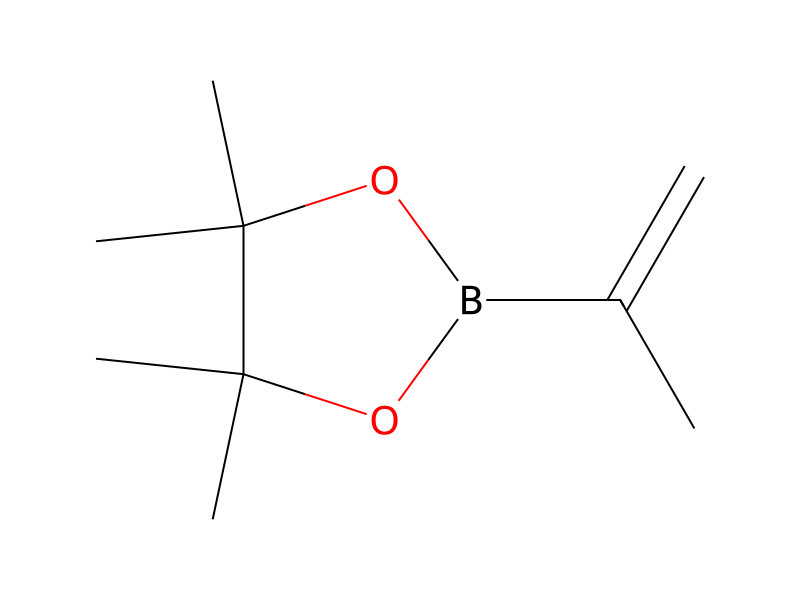
[Cl:1][C:2]1[C:3]([C:9]#[N:10])=[N:4][CH:5]=[C:6](Cl)[CH:7]=1.[CH3:11][C:12]1(C)[C:16](C)(C)OB(C(C)=C)O1.C(=O)([O-])[O-].[Na+].[Na+]>C1(C)C=CC=CC=1.C(O)C.C(OCC)(=O)C.O>[Cl:1][C:2]1[C:3]([C:9]#[N:10])=[N:4][CH:5]=[C:6]([C:12]([CH3:16])=[CH2:11])[CH:7]=1Participants
Reactant 3


Product 1

Reagents, catalysts & solvents 3



Procedure
A solution of 3,5-dichloropicolinonitrile (1.0 eq.), 4,4,5,5-tetramethyl-2-(prop-1-en-2-yl)-1,3,2-dioxaborolane (1.0 eq.), tetrakis(triphenyl-phosphine)palladium (5 mol %), and 2N aqueous sodium carbonate solution (3.4 eq.) in toluene/ethanol (2:1, 0.04 M) was stirred at 100° C. for 2 hours, then 80° C. for 4 hours. After cooling to ambient temperature, the reaction content was diluted with ethyl acetate and water. The two phases were separated, and the aqueous layer was extracted twice with ethyl acetate. The combined organic layers were washed with brine, dried over anhydrous MgSO4, and concentrated en vacuo. The crude product was purified by flash chromatography on a COMBIFLASH® system (ISCO) using 0-80% ethyl acetate in hexane to give 3-chloro-5-(prop-1-en-2-yl)picolinonitrile as a white solid.
Workup
- customThe two phases were separated
- extractionthe aqueous layer was extracted twice with ethyl acetate
- washThe combined organic layers were washed with brine
- dry with materialdried over anhydrous MgSO4
- concentrationconcentrated en vacuo
- customThe crude product was purified by flash chromatography on a COMBIFLASH® system (ISCO)
Sources & evidence
- ORD record
- ord-ed992e12288f405ab2b2da09acdc286f
- Source dataset
- uspto-grants-2014_11
- Patent number
- US08895577B2
Reaction notes
Loading…