Diethyl Ether → 2-(3-Chloro-2-methylsulphenylphenyl)-4,4-dimethyloxazoline
Reaction equation

C([Li])CCC.[Cl:6][C:7]1[CH:8]=[C:9]([C:13]2[O:14][CH2:15][C:16]([CH3:19])([CH3:18])[N:17]=2)[CH:10]=[CH:11][CH:12]=1.[CH3:20][S:21]SC.CCOCC>C1COCC1>[Cl:6][C:7]1[C:8]([S:21][CH3:20])=[C:9]([C:13]2[O:14][CH2:15][C:16]([CH3:19])([CH3:18])[N:17]=2)[CH:10]=[CH:11][CH:12]=1Participants
6
Reactant 4


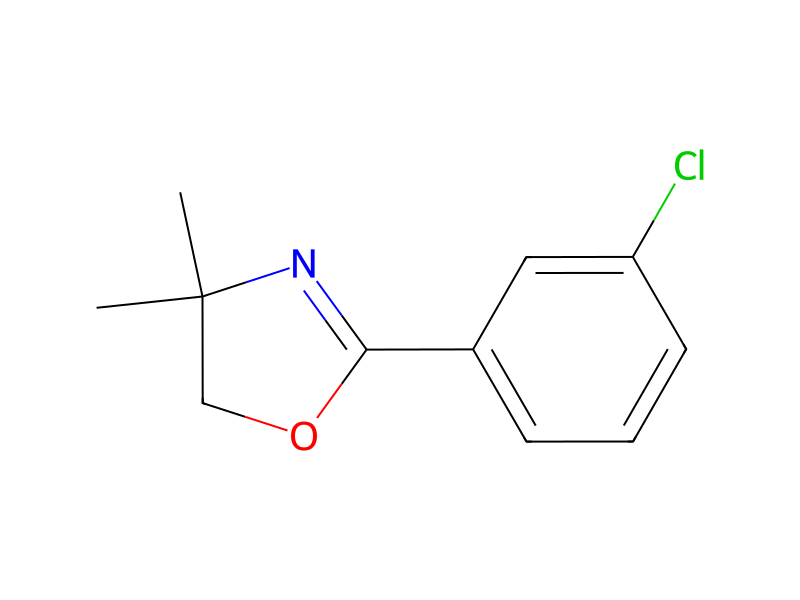

Product 1

Reagents, catalysts & solvents 1

Conditions
- Temperature
- -65 °C
Procedure
n-Butyllithium (2.5M in hexane, 4.2 ml) was added to a solution of 2-(3-chlorophenyl)-4,4-dimethyloxazoline (2 g) in THF while maintaining the temperature below -45° C. The mixture was stirred at -65° C. for 3 hours. Dimethyl disulphide (1.0 g) was added and the mixture was stirred at -65° C. for 2.5 hours and allowed to warm to room temperature. Ether was added and the mixture was washed with water, dried (MgSO4) and filtered. The filtrate was evaporated to dryness to give 2-(3-chloro-2-methylsulphenylphenyl)-4,4-dimethyloxazoline (2.35 g) as a yellow oil NMR (CDCl3) 2.0(s,6H) 3.0(s,3H) 4.65(s,2H) 7.5-8.1(m,3H).
Workup
- temperaturewhile maintaining the temperature below -45° C
- stirringthe mixture was stirred at -65° C. for 2.5 hours
- temperatureto warm to room temperature
- washthe mixture was washed with water
- dry with materialdried (MgSO4)
- filtrationfiltered
- customThe filtrate was evaporated to dryness
Sources & evidence
- ORD record
- ord-51803de05b404ec397fca9746d747480
- Source dataset
- uspto-grants-1999_01
- Patent number
- US05859283
Reaction notes
Loading…