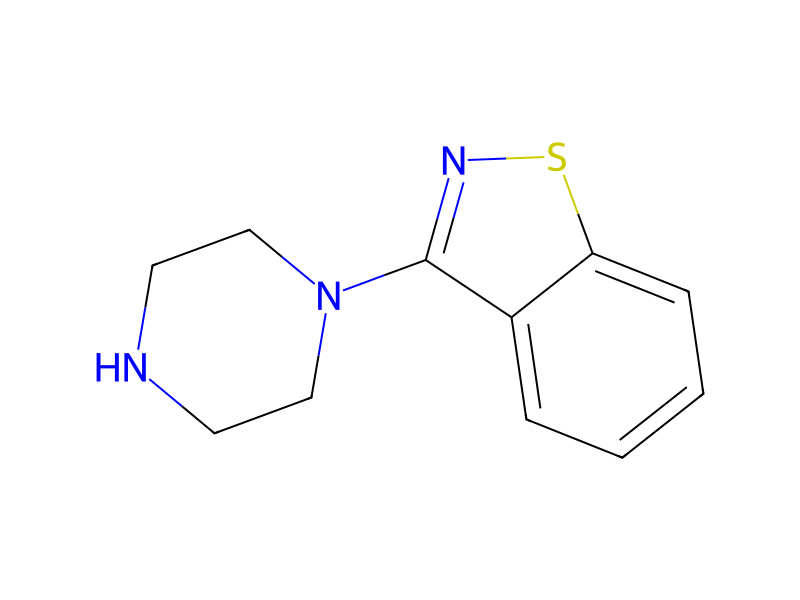
Piperazine → 3-(1-Piperazinyl)-1,2-benzisothiazole
Reaction equation

[NH:1]1[CH2:6][CH2:5][NH:4][CH2:3][CH2:2]1.ClC1C=CC=CC=1.Cl[C:15]1[C:19]2[CH:20]=[CH:21][CH:22]=[CH:23][C:18]=2[S:17][N:16]=1>C(O)CO>[N:1]1([C:15]2[C:19]3[CH:20]=[CH:21][CH:22]=[CH:23][C:18]=3[S:17][N:16]=2)[CH2:6][CH2:5][NH:4][CH2:3][CH2:2]1Participants
5
Reactant 3



Product 1
Reagents, catalysts & solvents 1

Procedure
215.4 g (2.50 mol) of piperazine, 50.0 g of chlorobenzene, 100.0 g of ethylene glycol were placed in a four-neck 1000 ml flask equipped with a stirrer, a thermometer, a dropping funnel and a condenser, 169.5 g (1.00 mol) of 3-chloro-1,2-benzisothiazole was added dropwise in the melted state at about 120° C. over 1 hour while stirring, which was thereafter stirred for 2 hours to complete the reaction. After excess piperazine was removed with water, the reaction mixture was made acidic with hydrochloric acid, extracted into an aqueous layer, which was made alkaline with aqueous sodium hydroxide to obtain 202.4 g (m.p. 89°-90° C.) of 3-(1-piperazinyl)-1,2-benzisothiazole as crystals. Yield from 3-chloro-1,2-benzisothiazole was 92.4%.
Workup
- customequipped with a stirrer
- stirringwhich was thereafter stirred for 2 hours
- customthe reaction
- customAfter excess piperazine was removed with water
- extractionextracted into an aqueous layer, which
Sources & evidence
- ORD record
- ord-ede2007e863e491c91da20a282468f06
- Source dataset
- uspto-grants-1999_01
- Patent number
- US05861511
Reaction notes
Loading…