Indole → HCID 18780221, compound
Reaction equation

C[Mg]I.[NH:4]1[C:12]2[C:7](=[CH:8][CH:9]=[CH:10][CH:11]=2)[CH:6]=[CH:5]1.Br[C:14]1[C:15](=[O:29])[NH:16][C:17](=[O:28])[C:18]=1[C:19]1[CH:24]=[CH:23][C:22]([N+:25]([O-:27])=[O:26])=[CH:21][CH:20]=1>C(OCC)C.C1C=CC=CC=1>[NH:4]1[C:12]2[C:7](=[CH:8][CH:9]=[CH:10][CH:11]=2)[C:6]([C:14]2[C:15](=[O:29])[NH:16][C:17](=[O:28])[C:18]=2[C:19]2[CH:20]=[CH:21][C:22]([N+:25]([O-:27])=[O:26])=[CH:23][CH:24]=2)=[CH:5]1Participants
Reactant 3
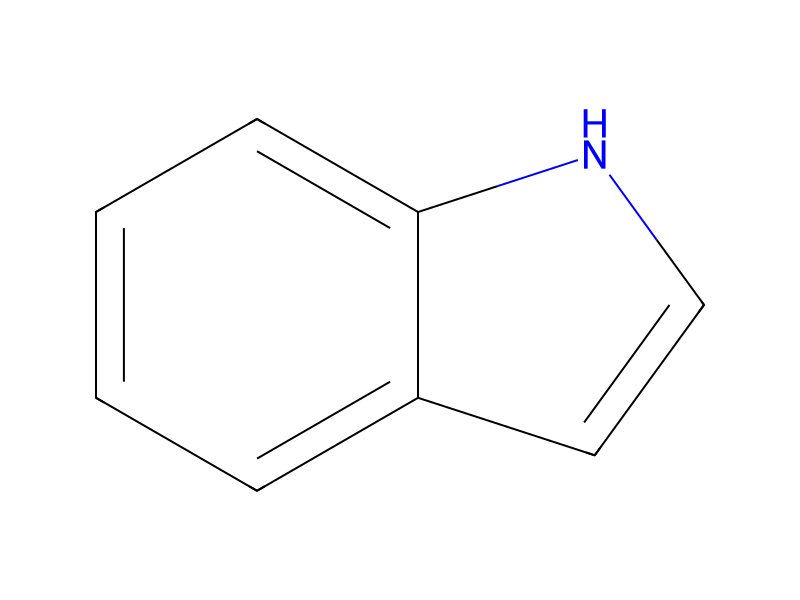


Product 1

Reagents, catalysts & solvents 2


Procedure
1.4 ml of a 3M solution of methylmagnesium iodide in diethyl ether was added to a solution of 360 mg indole in 20 ml of benzene under nitrogen. After stirring at room temperature for 10 minutes 300 mg of 3-bromo-4-(4-nitrophenyl)-1H-pyrrole-2,5-dione were added and the resulting mixture was heated to reflux for 4 days. After cooling the solution was evaporated and the residue was partitioned between dichloromethane and 2M hydrochloric acid. The organic phase was washed with water, dried and evaporated. The residue was purified on silica gel with dichloromethane and 1% methanol in dichloromethane and then with 20% methanol/water on Hypersil to give 3 mg of 3-(3-indolyl)-4-(4-nitrophenyl)-1H-pyrrole-2,5-dione, m.p. 125° C. (decomposition).
Workup
- additionwere added
- temperaturethe resulting mixture was heated
- temperatureto reflux for 4 days
- temperatureAfter cooling the solution
- customwas evaporated
- customthe residue was partitioned between dichloromethane and 2M hydrochloric acid
- washThe organic phase was washed with water
- customdried
- customevaporated
- customThe residue was purified on silica gel with dichloromethane and 1% methanol in dichloromethane
Sources & evidence
- ORD record
- ord-71a127b425274df1a7f45a54e215080b
- Source dataset
- uspto-grants-1991_10
- Patent number
- US05057614
Reaction notes
Loading…