5-Fluoro-1-(4-methoxybenzyl)indoline-2,3-dione → 5-Fluoro-1-(4-methoxy-benzyl)-1,3-dihydro-indol-2-one
Reaction equation

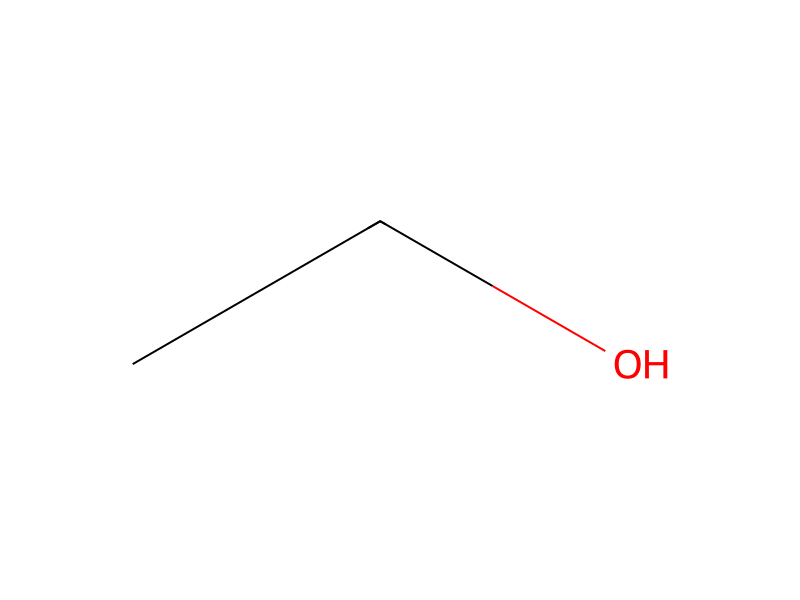
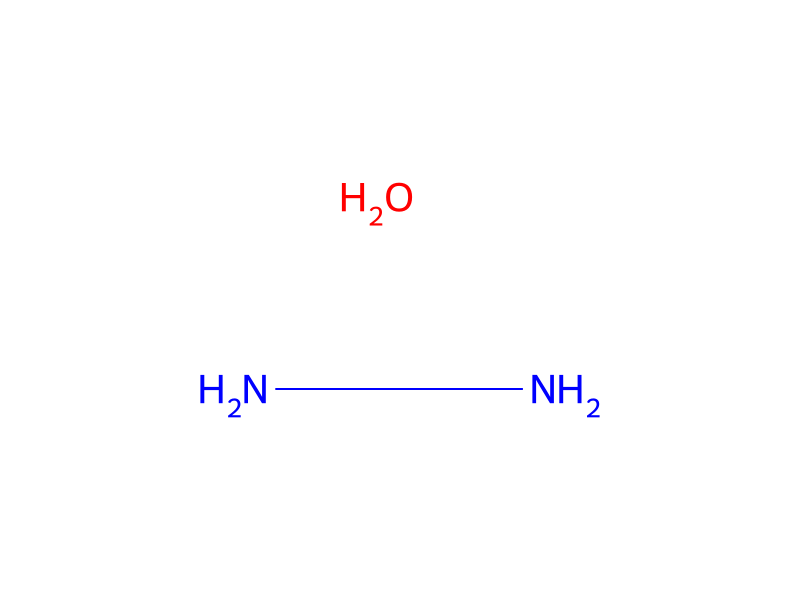
[F:1][C:2]1[CH:3]=[C:4]2[C:8](=[CH:9][CH:10]=1)[N:7]([CH2:11][C:12]1[CH:17]=[CH:16][C:15]([O:18][CH3:19])=[CH:14][CH:13]=1)[C:6](=[O:20])[C:5]2=O>O.NN.C(O)C.O>[F:1][C:2]1[CH:3]=[C:4]2[C:8](=[CH:9][CH:10]=1)[N:7]([CH2:11][C:12]1[CH:17]=[CH:16][C:15]([O:18][CH3:19])=[CH:14][CH:13]=1)[C:6](=[O:20])[CH2:5]2Participants


Procedure
A solution of 5-fluoroisatin (5 g, 30.2 mmol) in DMF (60 mL) was cooled in an ice/water bath and treated with sodium hydride (1.44 g, 60.6 mmol) portionwise. The reaction was stirred for 15 minutes after the addition of the last portion and then treated with p-methoxybenzyl chloride (5.32 g, 45.3 mmol) and allowed to stir for 1 hour. The reaction was then quenched by slow addition of excess methanol. After bubbling had stopped, the reaction was poured into water (100 mL) and extracted twice with ethyl acetate. The organics were combined, dried over MgSO4 and the solvent was removed. The residue was purified by silica gel chromatography using a gradient of 0–100% ethyl acetate in hexane to afford 7.1 g (82%) of 5-Fluoro-1-(4-methoxy-benzyl)-1H-indole-2,3-dione; 1H NMR (CDCl3, 400 MHz) δ 3.79 (s, 3H), 4.86 (s, 2H), 6.75 (dd, 1H, J1=3.6, J2=8.6), 6.84–6.90 (m, 2H), 7.19 (ddd, 1H, J1=J2=8.6, J3=3.6), 7.22–7.27 (m, 1H), 7.26–7.31 (m, 2H); HPLC-MS calcd. for C16H12FNO3 (M+H+) 286.1. found 286.3. Step B: A solution of 5-fluoro-1-(4-methoxy-benzyl)-1H-indole-2,3-dione (7.1 g, 24.9 mmol) in hydrazine hydrate (35 mL) and ethanol (15 mL) was refluxed overnight, diluted with water and extracted twice with ethyl acetate. The combined organics were dried over Na2SO4, filtered and concentrated. The residue was purified by silica gel chromatography using a gradient of 0–100% ethyl acetate in hexane to afford 6.1 g (90%) of 5-fluoro-1-(4-methoxy-benzyl)-1,3-dihydro-indol-2-one; 1H NMR (CDCl3, 400 MHz) δ 3.59 (s, 2H), 3.77 (s, 3H), 4.83 (s, 2H), 6.63 (dd, 1H, J1=4.2, J2=8.6), 6.82–6.91 (m, 3H), 6.96–7.01 (m, 1H), 7.19–7.23 (m, 1H), 7.27–7.31 (m, 1H); HPLC-MS calcd. for C16H14FNO2 (M+H+) 272.1. found 272.3. Step C: A solution of 5-fluoro-1-(4-methoxy-benzyl)-1,3-dihydro-indol-2-one (6.12 g, 22.6 mmol) in DMF (65 mL) was cooled in an ice/water bath and treated with dibromoethane (6.35 g, 33.8 mmol) followed by sodium hydride (1.09 g, 45 mmol) portionwise. After stirring at 0° C. for 1 hour, the reaction was cooled to −78° C. and treated with excess methanol. After bubbling had stopped, the reaction was poured into water (100 mL) and extracted twice with ethyl acetate. The organics were combined, dried over Na2SO4 and the solvent was removed. The residue was purified by silica gel chromatography using a gradient of 0–100% ethyl acetate in hexane to afford 4.1 g (61%) of 5-fluoro-1-(4-methoxy-benzyl)-siprocyclopropyloxindole; 1H NMR (CDCl3, 400 MHz) δ 1.54 (dd, 2H, J1=4.0, J2=7.8), 1.83 (dd, 2H, J1=4.3, J2=8.1), 3.77 (s, 3H), 4.91 (s, 2H), 6.57 (dd, 1H, J1=2.5, J2=8.0), 6.69 (dd, 1H, J1=4.2, J2=8.5), 6.81 (dd, 1H, J1=2.5, J2=9.3), 6.83–6.87 (m, 2H), 7.22–7.25 (m, 2H); HPLC-MS calcd. for C18H16FNO2 (M+H+) 298.1. found 298.3. Step D: A solution of 5-fluoro-1-(4-methoxy-benzyl)-siprocyclopropyloxindole (3.38 g, 11.4 mmol) in TFA (20 mL) was stirred at 60° C. overnight. The solvent was then removed and the reaction was diluted with ethyl acetate and washed with saturated aqueous NaHCO3 until the washings were neutral. The organic phase was then washe with brine, dried over Na2SO4 and the solvent was removed. The residue was purified by silica gel chromatography using a gradient of 0–100% ethyl acetate in hexane to afford 1.94 g (96%) of 5-fluoro-siprocyclopropyloxindole; 1H NMR (MeOD, 400 MHz) δ 1.76–1.86 (m, 4H), 6.91–6.94 (m, 1H), 7.07–7.11 (m, 2H); HPLC-MS calcd. for C10H8FNO (M+H+) 178.2. found 178.3. Step E: A sample of 5-fluoro-siprocyclopropyloxindole (172 mg, 97 μmol) was cooled in an ice/water bath and treated with a 1.0 M solution of LAH (1.94 ml, 1.9 mmol). The reaction was stirred at room temperature for 15 minutes and then at 50° C. for 3 hours and finally was cooled back down with an ice/water bath. The reaction was treated with 1 M NaOH (1.9 mL) followed by water (1.9 mL). The reaction was filtered over celite and dried over MgSO4. After filtration, the solvent was removed and the crude material of 5-fluoro-siprocyclopropylindoline was used as the indoline partner to prepare [1-Cyclopropyl-2-(5-fluoro-3,3-spirocycloprpyl-indol-1-yl)-ethyl]-carbamic acid benzyl ester in 62% yield in an analogous manner to example 12, step A; HPLC-MS calcd. for C23H25FN2O2 (M+H+) 381.2. found 381.4. In addition, synthesis of other 3,3-spiro-cycloalkylindolines are also described in (1) Jackson, A. H. et al. Tetrahedron (1968), 24(1), 403–13; (2) Jansen, A. B. A. et al. Tetrahedron (1965), 21(6), 1327–31; (3) Bermudez, J. et al. J.Med. Chem. (1990), 33(7), 1929–32; (4) Nishio, T. et al. Helv. Chim. Acta (1990), 73(6), 1719–23; (5) Nishio, T. et al. J. Chem. Soc., Perkin Trans 1 (1991), (1), 141–3; (6) Kucerovy, A. et al. Synth. Commun. (1992), 22(5), 729–33; (7) Kato, M. et al. Chem. Pharm. Bull. (1995), 43(8), 1351-7.
Workup
- extractionextracted twice with ethyl acetate
- dry with materialThe combined organics were dried over Na2SO4
- filtrationfiltered
- concentrationconcentrated
- customThe residue was purified by silica gel chromatography
Sources & evidence
- ORD record
- ord-01b4302f42ec47e09475896c826d81a5
- Source dataset
- uspto-grants-2007_02
- Patent number
- US07173051B2
Reaction notes
Loading…