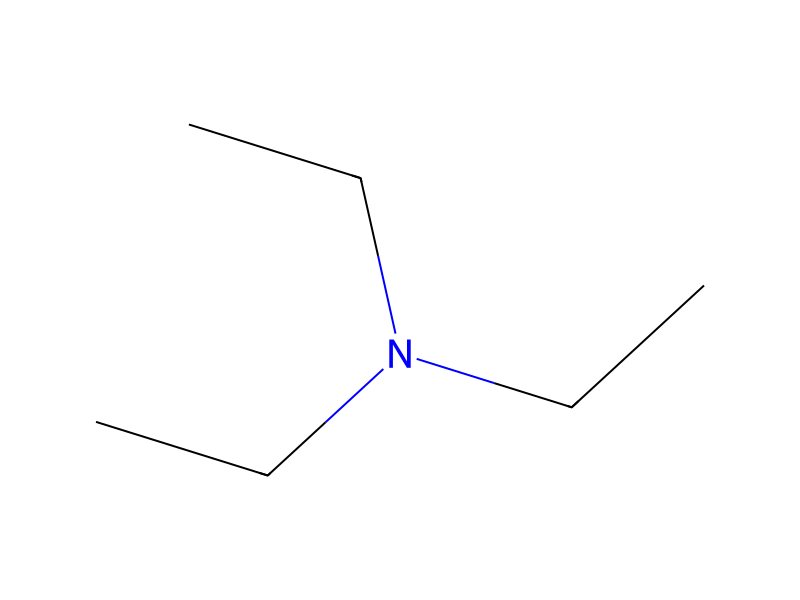
Triethylamine → Methyl 2-((2-(tert-butyl)phenyl)amino)-2-oxoacetate
Reaction equation

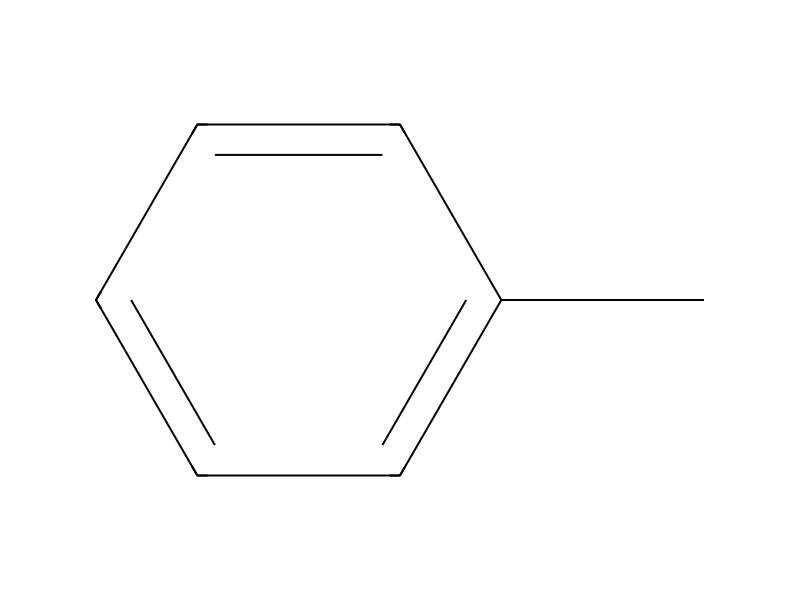
[C:1]([C:5]1[CH:11]=[CH:10][CH:9]=[CH:8][C:6]=1[NH2:7])([CH3:4])([CH3:3])[CH3:2].C(N(CC)CC)C.Cl[C:20](=[O:25])[C:21]([O:23][CH3:24])=[O:22]>C1(C)C=CC=CC=1>[C:1]([C:5]1[CH:11]=[CH:10][CH:9]=[CH:8][C:6]=1[NH:7][C:20](=[O:25])[C:21]([O:23][CH3:24])=[O:22])([CH3:4])([CH3:2])[CH3:3]Participants
Reactant 3


Product 1

Reagents, catalysts & solvents 1
Conditions
- Temperature
- -30 °C
Procedure
A 3-L, 3-necked round-bottomed flask, equipped with a mechanic stirrer and a thermal probe (under nitrogen) was charged with 2-tert-Butylaniline (109 g, 114 mL, 732 mmoles), triethylamine (81.4 g, 112 mL, 804 mmoles, 1.1 equiv.) and toluene (600 mL). The resulting mixture was stirred at a moderate speed at −30° C. An additon funnel was charged with Methyl chlorooxoacetate (100 g, 816 mmoles, 1.11 equiv.) with toluene (200 mL), and the mixture added to the reaction mixture at such a rate that the internal batch temperature is less than −20° C. After addition, the reaction was warmed to room temperature for an hour, quenched with water, then partitioned between EtOAc/water. The aqueous phase was extracted with EtOAc (200 mL), and the combined organic layers were washed successively with KHSO4 (200 mL), NaHCO3 (sat'd) (200 mL) and brine (200 mL), then dried the organic over MgSO4. The organic phase was concentrated by rotary evaporation, yielding the title compound as a pale yellow solid [Methyl 2-(2-tert-Butylphenylamino)-2-oxoacetate, 160 g, 93.1%]. MP 61.7–63.6° C. IR (KBr) 3409, 2954, 1736, 1724, 1530, 1299, 1166, 766 cm−1; 1H NMR (300 MHz, CDCl3): δ(ppm): 9.20 (br, 1H), 7.97 (dd, J=7.8 Hz, J′=1.8 Hz, 1H), 7.43 (dd, J=7.8 Hz, J′=1.8 Hz, 1H), 7.31–7.16 (m, 2H), 4.00 (s, 3H), 1.47(s, 9H). The product thus obtained can be used directly for the subsequent reaction.
Workup
- additionthe mixture added to the reaction mixture at such a rate that the internal batch temperature
- customis less than −20° C
- additionAfter addition
- temperaturethe reaction was warmed to room temperature for an hour
- customquenched with water
- custompartitioned between EtOAc/water
- extractionThe aqueous phase was extracted with EtOAc (200 mL)
- washthe combined organic layers were washed successively with KHSO4 (200 mL), NaHCO3 (sat'd) (200 mL) and brine (200 mL)
- dry with materialdried the organic over MgSO4
- concentrationThe organic phase was concentrated by rotary evaporation
Sources & evidence
- ORD record
- ord-ab8a21ff363f43329939b75d6a6be499
- Source dataset
- uspto-grants-2007_02
- Patent number
- US07183260B2
Reaction notes
Loading…